
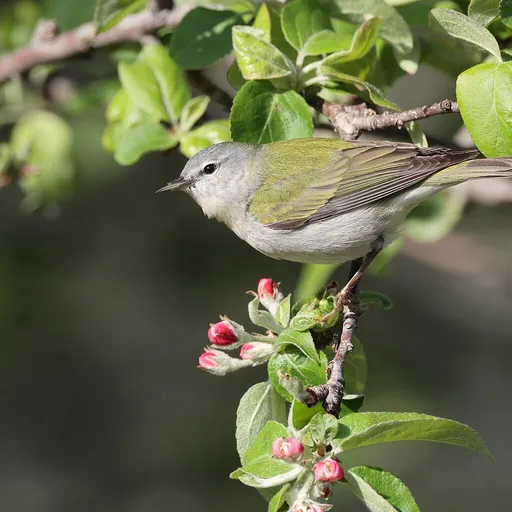
Tennessee Warbler
Leiothlypis peregrina
Least Concern
Overview
The Tennessee warbler (Leiothlypis peregrina) is a New World warbler that breeds in eastern North America and winters in southern Central America, the Caribbean, and northern South America. The species is classified as Least Concern on the IUCN Red List.
Identification
- An 11.5 cm long bird with long wings, a short tail, and a thin, pointy bill.
- Breeding males feature an olive back and rump, a slate gray neck and crown, and a gray-white underside, while females are duller with yellow and olive tinges.
- Both sexes possess white undertail coverts year-round, and in winter adult males display a yellow supraocular line on their olive-green heads.
- Can be confused with the red-eyed vireo, which is larger and sings almost constantly, or the orange-crowned warbler, which lacks a white eyebrow.
Habitat
The species prefers coniferous forests, mixed conifer-deciduous forests, early successional woodlands, and boreal bogs. It breeds in the north-eastern and northern Mid-West of the United States and across much of Canada, wintering in southern Central America, the Caribbean, and northern Colombia and Venezuela.
Diet
This warbler feeds mainly on insects, with a particular preference for the spruce budworm, as well as flower nectar, fruit, and some seeds. It is nervous and quick while foraging, creeping along branches at all levels.
Did you know?
The bird was named by Alexander Wilson, who discovered an individual by Tennessee's Cumberland River in 1832, despite this location being outside of the species's usual range.
Sources
- Wikipedia · CC BY-SA 4.0
- Wikidata · CC0 1.0