
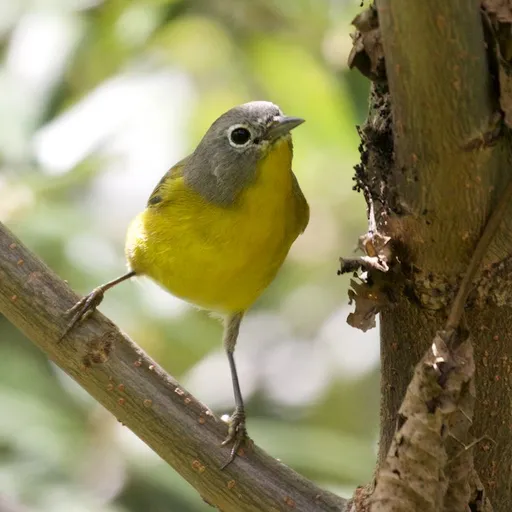
Nashville Warbler
Leiothlypis ruficapilla
Least Concern
Overview
The Nashville warbler (Leiothlypis ruficapilla) is a small songbird in the New World warbler family found across North and Central America. It breeds in parts of the northern and western United States and southern Canada, migrating to winter in southern California, Texas, Mexico, and northern Central America.
Identification
- Small warbler measuring 11–13 cm in length with a gray head fading into a greenish back and wings.
- Underparts feature a white belly with a yellow throat and breast; adult males possess a rusty brown crown patch that is often hidden by gray feathers.
- Distinguished by a complete white eye ring, no wing bars, and a thin pointed black bill.
- Song of the eastern subspecies consists of a rapid seewit-seewit-seewit-ti-ti-ti, while the call resembles a high seet.
Habitat
Breeding populations prefer open mixed woods and bog habitats in distinct areas of the northeastern and western United States, as well as parts of Canada. During the winter, the species migrates to southernmost Texas and California, mid-Mexico, and the northernmost parts of Central America, including Guatemala and El Salvador.
Diet
These birds forage by gleaning in the lower parts of trees and shrubs, frequently flicking their tails. They mainly consume insects but will supplement their diet with berries and nectar during the winter months.
Did you know?
Despite being named after Nashville, Tennessee, the bird only visits that area during migration and does not breed there.
Sources
- Wikipedia · CC BY-SA 4.0
- Wikidata · CC0 1.0