
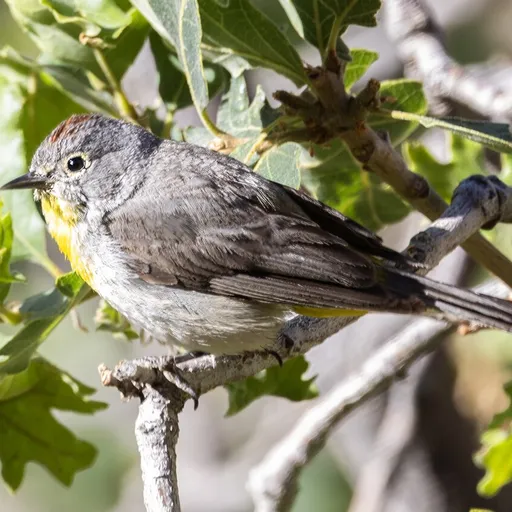
Virginia's Warbler
Leiothlypis virginiae
Least Concern
Overview
Virginia's warbler (Leiothlypis virginiae) is a species of New World warbler that is classified as Least Concern on the IUCN Red List. Despite its name, it is not named after the American state of Virginia, but rather after Virginia Anderson, the wife of an army surgeon who first discovered the species in 1858.
Identification
- A small bird measuring 100 to 110 mm (4 to 4.5 inches) in length.
- Primarily grey plumage with a lighter under-belly, a white eye ring, and a yellow patch on the breast.
- Features a yellow rump and undertail coverts, as well as a partially hidden dark reddish crest.
- Females appear slightly duller with less yellow on the breast compared to males.
Habitat
This species thrives in dense oak and pinyon woodlands and brushy streamside hills at altitudes between 1,800 and 2,700 m. Its summer range covers the south-western United States, including central and southern mountains of Colorado, central Wyoming, and central and western New Mexico, while wintering as far south as Belize and visiting several Caribbean islands.
Did you know?
The bird is not named after the American state of Virginia, but after Virginia Anderson, whose husband's colleague, Spencer Fullerton Baird, honoured her as the namesake when formally describing the species in 1860.
Sources
- Wikipedia · CC BY-SA 4.0
- Wikidata · CC0 1.0