
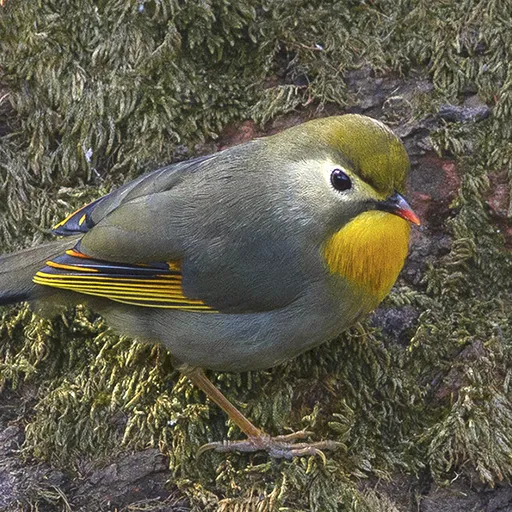
Red-billed Leiothrix
Leiothrix lutea
Least Concern
Overview
The red-billed leiothrix (Leiothrix lutea) is a small passerine bird native to southern and eastern China and the Himalayas, though it has also become naturalised in parts of Japan and Europe. It is a common cagebird known by several misleading names, such as the Pekin robin or Japanese nightingale, neither of which accurately reflect its taxonomy or origin. The species is classified as Least Concern on the IUCN Red List.
Identification
- 14–15.5 cm in length with a bright red bill, pinkish legs, and a brown eye surrounded by a yellowish-white ring.
- Dull olive green back, bluish-grey cheeks, and a bright yellow-orange throat with a yellow chin; wing feather edges are brightly coloured with yellow, orange, red, and black.
- Females are slightly smaller and duller with less red on the wings, while juveniles have black bills and even duller plumage.
- Highly active but often secretive, possessing an excellent song of short, powerful notes repeated continuously, which becomes more persistent during the breeding season.
Habitat
Found throughout southern and eastern China, and west along the Himalayas in northern India, Bhutan, Nepal, Burma, and parts of Tibet. It inhabits all types of jungle from sea level to 3,400 m, with a preference for pine forests featuring dense bushes and undergrowth. In Bhutan, the species undertakes altitudinal migration, breeding at higher elevations in summer and descending in winter.
Diet
Consumes invertebrates such as insects, spiders, millipedes, and molluscs, alongside fruit like strawberries, papaya, and guava, and grass seeds. Foraging usually occurs in the lower strata of vegetation below 3 m, gathering food from foliage and dead wood, though it also flycatches for insects and picks them off higher foliage.
Did you know?
Although commonly known in the bird trade as the Japanese nightingale or Pekin robin, the bird is not native to Japan nor is it a robin or a nightingale. Newly hatched chicks possess bright red skin and a rich orange-red gape, and their eggs feature a pale blue colour with red-brown spots encircling the larger end.
Sources
- Wikipedia · CC BY-SA 4.0
- Wikidata · CC0 1.0