
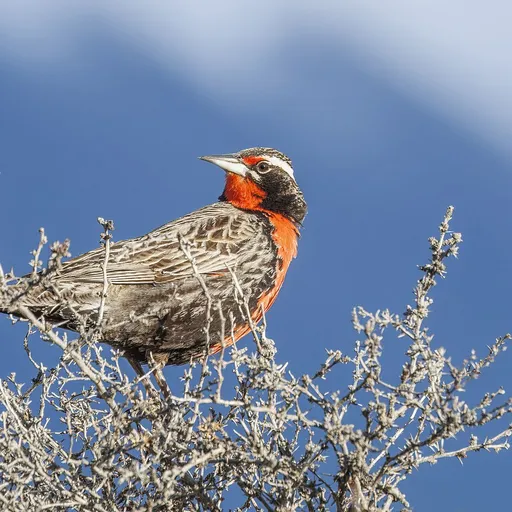
Long-tailed Meadowlark
Leistes loyca
Least Concern
Overview
The long-tailed meadowlark (Leistes loyca) is a passerine bird in the family Icteridae, comprising New World orioles and blackbirds. It inhabits Argentina, Chile, and the Falkland Islands, where the island subspecies is locally known as the 'military starling'. The species is assessed as Least Concern on the IUCN Red List.
Identification
- Males average 27 cm in length and feature a mostly blackish head with a supercilium that is red from the bill to the eye and white beyond it, along with a short white 'moustache'.
- Adult males have rosy red chins, throats, and breasts with blackish sides, a black belly, and flanks striped with buffish and black; females have an all-white supercilium and a white throat.
- Both sexes possess a bluish ivory bill with a blackish brown tip, gray-brown legs, and a dark brown iris.
- The song is described as a descending 'chup chup chup tchew ee chew chewee chweeeew', with calls sounding like 'peet and chuck'.
Habitat
Found in a disjunct distribution across Chile, Argentina, and the Falkland Islands, the species primarily occupies moderately moist to dry grassland and steppe. In the dry Andes, it favours areas near marshes or watercourses and irrigated fields, while in Patagonia it inhabits moist shrub-steppe and the edges of Nothofagus forest. The Falkland Islands subspecies favours fields of whitegrass (Cortaderia pilosa) and settlements.
Diet
The long-tailed meadowlark feeds mostly on insects, with other arthropods and fruits forming a minor part of its diet; it has also been observed feeding on maize in Argentina and growing potatoes in the Falklands. It forages mostly on the ground, turning over debris to expose prey, and in low vegetation, while commonly perching on fenceposts, rocks, and shrubs. Foraging often occurs in flocks that may reach 100 individuals in the non-breeding season.
Did you know?
The island subspecies is locally known in the Falklands as the 'military starling'. In Argentina, the species is subject to brood parasitism by the shiny cowbird (Molothrus bonariensis).
Sources
- Wikipedia · CC BY-SA 4.0
- Wikidata · CC0 1.0