
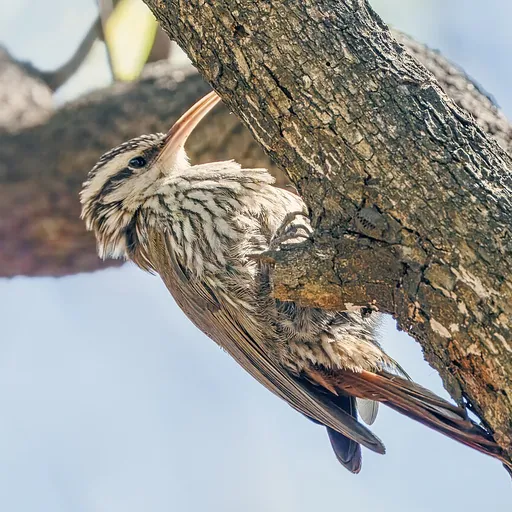
Narrow-billed Woodcreeper
Lepidocolaptes angustirostris
Least Concern
Overview
The narrow-billed woodcreeper (Lepidocolaptes angustirostris) is a slim, medium-sized bird in the ovenbird family Furnariidae. It is a year-round resident found across parts of South America and is currently classified as Least Concern on the IUCN Red List.
Identification
- Plumage: Adults have a blackish-brown crown and nape with whitish buff streaks, a black stripe behind the eye, and a widening buffy-white supercilium that becomes broken spots; the back is rufous brown with an olive tinge, while the throat and cheeks are plain whitish.
- Bill: Long, slim, and moderately decurved, pale gray to pinkish horn with dusky sides on the base of the mandible.
- Size: 18 to 22 cm long, with males weighing 23 to 37.5 g and females 21.5 to 33.5 g.
- Song: A loud series 3–5 seconds long consisting of 4–8 sharp descending notes, which may sound like clear whistles ('peer, peer'), slurred repetitions ('drewEEew'), or notes that accelerate and fade ('peeé, pee-pee-pee').
Habitat
This species inhabits a variety of semi-open and open landscapes, including deciduous forest, Gran Chaco woodlands, gallery forest, caatinga, and cerrado, reaching altitudes of 1,200 m in most of its range and up to 3,000 m in Bolivia. Its range covers Argentina, Bolivia, Brazil, Paraguay, Suriname, and Uruguay, where it is often found in open parts of populated areas and plantations.
Diet
The narrow-billed woodcreeper feeds mostly on invertebrates such as insects and spiders, though it has occasionally been observed taking small frogs. It forages singly or in pairs by hitching up trunks in a spiral from the ground to the subcanopy, capturing prey by gleaning surfaces, probing bark crevices and moss, or flaking off bark, and has even been seen catching moths around street lights.
Did you know?
The bird is quite adaptable to human environments, nesting not only in natural cavities or woodpecker holes but also in human constructs such as bridge supports, and it is notably not adversely affected by forest fragmentation in southern Brazil.
Sources
- Wikipedia · CC BY-SA 4.0
- Wikidata · CC0 1.0