
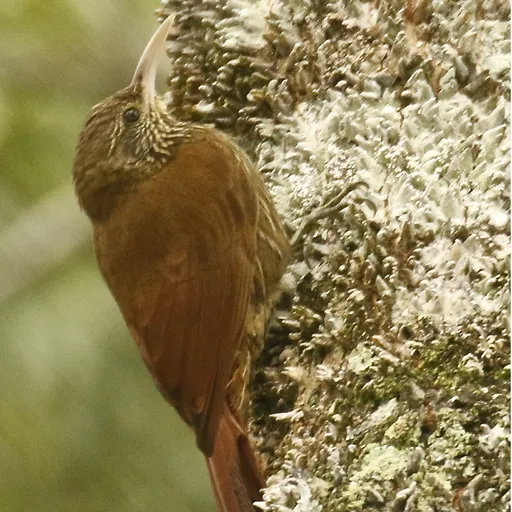
Duida Woodcreeper
Lepidocolaptes duidae
Least Concern
Listen
XC251046 · Niels Krabbe · Zamora-Chinchipe: 'Cabañas Yankuam' 2 km S Las Orchideas, Nangaritza Valley, Ecuador · CC BY-SA 4.0
Overview
The Duida woodcreeper, Lepidocolaptes duidae, is a small bird in the ovenbird family Furnariidae. It was recognised as a distinct species in the 2010s after being separated from the lineated woodcreeper.
Identification
- A smallish, slim bird measuring 17 to 19 cm in length, with a slim, decurved bill.
- Plumage is sexually dimorphic in age but not sex; adults feature dusky brown heads, dark russet-brown backs, and rufous-chestnut wings and tails.
- Underparts are greyish or olive-brown with bold, pale buff to creamy white streaks edged in blackish.
- Song consists of 8–12 high-pitched, thin notes delivered in 2.5 seconds, often transcribed as 'peer, peer, peer, pi, pi, pi...'
Habitat
Native to the northwestern Amazon Basin across parts of Brazil, Ecuador, Peru, and Venezuela, with a hypothetical presence in eastern Colombia. It inhabits terra firme and floodplain forests, favouring the interior and edges of tall primary and mature secondary forests, and rarely descends below 1,000 m.
Diet
Its diet consists primarily of arthropods, which it forages for by hitching along branches, often on their undersides, within the sub-canopy and canopy. It picks, probes, and pries prey from bark and occasionally probes vegetation, though it rarely sallies for airborne insects.
Did you know?
As a specialist of the forest canopy, the Duida woodcreeper is poorly understood and likely highly sensitive to habitat modification, yet its population size remains unknown despite its wide range.
Sources
- Wikipedia · CC BY-SA 4.0
- Wikidata · CC0 1.0