
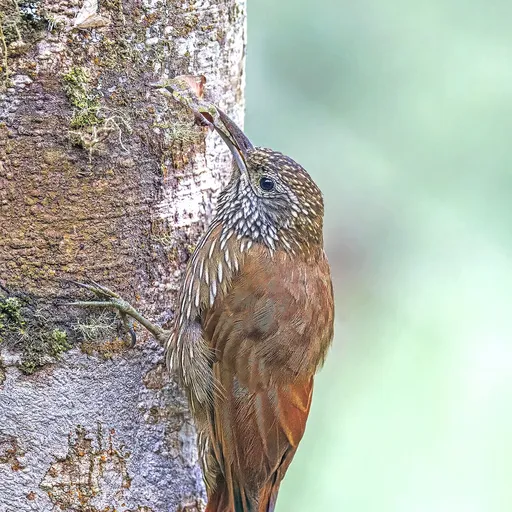
Montane Woodcreeper
Lepidocolaptes lacrymiger
Least Concern
Listen
XC250330 · Niels Krabbe · Loja: between Utuana and Sozoranga, Ecuador · CC BY-SA 4.0
Overview
The montane woodcreeper (Lepidocolaptes lacrymiger) is a perching bird in the ovenbird family Furnariidae. It is a small to medium-sized species found across the Andean region of South America, primarily within Bolivia, Colombia, Ecuador, Peru, and Venezuela.
Identification
- Length of 19 to 19.5 cm with a slim, slightly decurved bill; males weigh 31–35 g and females 29.5–33 g.
- Plumage is rufous-brown on the back and wings, with olive-brown underparts marked by long, wide, black-edged buff streaks.
- The face and neck are distinctly streaked, featuring a often-broken whitish supercilium and a dusky crown with spotted markings that transition to streaks on the nape.
- Song consists of a 2.5-second series of 10–15 high-pitched whistles that accelerate and descend, described as 'tsip, tsip, tsip, ts-ts-tseeeéu, tseeu, tseu-tseu-tseu-tseu'.
Habitat
Found in varied forested landscapes at mid- to upper elevations, typically between 1,750 and 3,000 m, though occasionally as low as 900 m in Venezuela. The species favours montane evergreen forest and cloudforest, but also inhabits open woodland, deciduous forests, and stunted forests near the treeline. It is often found at the edges of primary forests and in mature secondary growth rather than the deep interior.
Diet
The diet consists primarily of arthropods, though it is not fully detailed. Foraging occurs singly or in pairs, and the bird regularly joins mixed-species feeding flocks but does not follow army ant swarms. It captures prey by gleaning from surfaces and probing bark crevices, epiphytes, and moss while hitching up trunks and the undersides of branches.
Did you know?
Although the bird is not highly vocal, its song is a rapid, accelerating sequence of 10 to 15 whistles that descends in pitch. Breeding pairs are believed to remain together year-round, with both sexes participating in the care of their young.
Sources
- Wikipedia · CC BY-SA 4.0
- Wikidata · CC0 1.0