
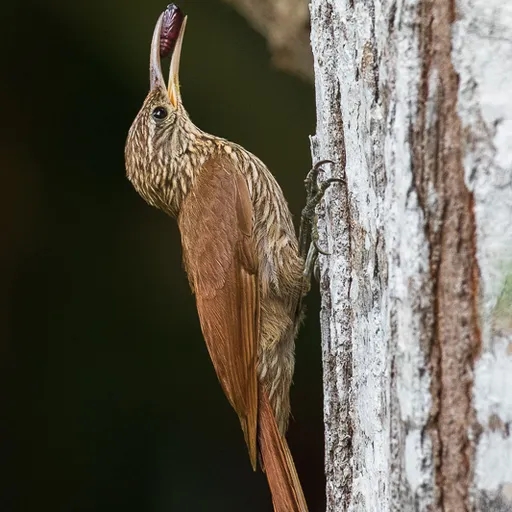
Streak-headed Woodcreeper
Lepidocolaptes souleyetii
Least Concern
Listen
XC250362 · Niels Krabbe · Loja: Tambo Negro 10 km E Macará, Ecuador · CC BY-SA 4.0
Overview
The streak-headed woodcreeper (Lepidocolaptes souleyetii) is a passerine bird within the ovenbird family Furnariidae. It is a year-round resident across much of its range and is classified as a species of Least Concern by the IUCN.
Identification
- Slim, medium-sized bird measuring 19 to 21 cm in length with a longish, slender, decurved bill.
- Face features thin whitish buff and dark brown streaks, a whitish buff supercilium, and eyering.
- Crown and nape are dark brown with bold whitish buff streaks that often extend onto the upper back, while back and wing coverts are rufous-olive to cinnamon-brown.
- Underparts are grayish olive to buffy brown with black-edged whitish buff streaks that are wider on the breast and narrower on the belly and flanks.
- Song is described as a simple, descending, clear trill that is soft and melodious, lasting between 1.5 and 3 seconds.
Habitat
Found in Mexico, Central America, Brazil, Colombia, Ecuador, Guyana, Peru, Venezuela, and Trinidad, the species inhabits a variety of wooded landscapes, mostly semi-open to open areas. It thrives in deciduous and somewhat humid forest, gallery forest, secondary forest, plantations, and forest edges, though it locally occurs in mangroves and arid scrublands. Its elevation range varies by region, generally reaching up to 1,850 m in northern Central America but often staying below 800 m in Ecuador.
Diet
The diet consists mainly of non-flying arthropods, with minor components including other invertebrates such as crabs and small fruits. It forages mostly singly or in pairs at all levels of the forest, hitching up trunks and branches. Prey is captured by flaking bark and probing into crevices and moss clumps.
Did you know?
The species' specific epithet commemorates Louis François Auguste Souleyet, a French zoologist and naval surgeon. Its breeding season varies geographically, occurring in June and July in Mexico but extending from April to October in Colombia.
Sources
- Wikipedia · CC BY-SA 4.0
- Wikidata · CC0 1.0