
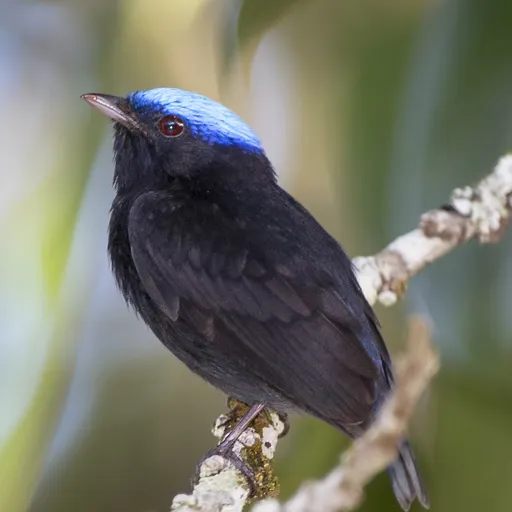
Blue-capped Manakin
Lepidothrix coronata
Least Concern
Listen
XC249021 · Niels Krabbe · Orellana: 'Maxus' road km 37 (27 km SSE Pompeya), Ecuador · CC BY-SA 4.0
Overview
The blue-capped manakin (Lepidothrix coronata) is a species of bird in the family Pipridae, characterised by a brilliant blue cap on males. It is found in the moist lowland forests of South America and is currently classified as Least Concern on the IUCN Red List, though its population trend is decreasing.
Identification
- Males display sooty black plumage with a bright blue crown, while females are green.
- Juveniles resemble females but possess duller plumage.
- The contact call is a sweet, high-pitched note that increases in pitch from 2.8 to 5.7 kHz, used by all ages and sexes.
- Territorial males produce an advertisement call resembling chi-wrr.
- Small body size, with females averaging 9.8 g and males 8.5 g in weight.
Habitat
This species inhabits the understory of terra firme (non-flooded) forests, as well as subtropical or tropical moist lowland forest and heavily degraded former forest. Its range extends across Bolivia, Brazil, Colombia, Ecuador, Peru, and Venezuela.
Diet
Blue-capped manakins are frugivores, feeding on fruit from Melastomataceae, Moraceae, Bromeliaceae, and Araceae. When foraging in mixed flocks, they prefer arthropods such as ants and flies, using a sally-strike or sally-glean technique to catch insects scattered by the flock.
Did you know?
Despite being flighted birds, large Amazonian rivers act as significant barriers to gene flow because these manakins prefer the understory of terra firme forests and tend not to cross them. The blue-capped manakin was formally described in 1825, with the specific epithet coronata derived from the Latin word coronatus, meaning crowned.
Sources
- Wikipedia · CC BY-SA 4.0
- Wikidata · CC0 1.0