
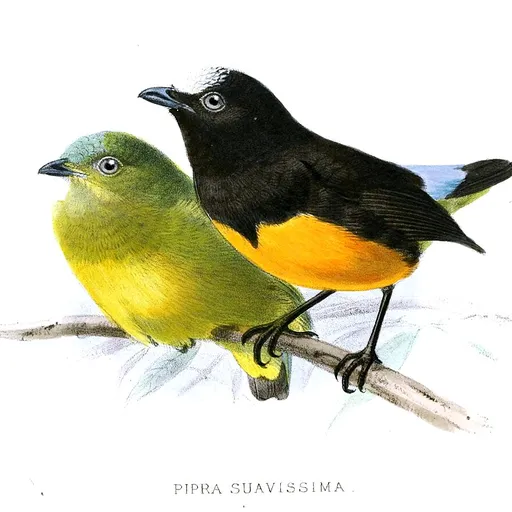
Orange-bellied Manakin
Lepidothrix suavissima
Least Concern
Overview
The orange-bellied manakin, also known as the tepui manakin, is a species of bird in the family Pipridae. It is a year-round resident found in southeastern Venezuela, northeastern Brazil, and central Guyana. The IUCN assesses its status as Least Concern.
Identification
- Males have a white forecrown, bright azure-blue lower rump and uppertail coverts, a yellow-orange belly, and otherwise black plumage.
- Females feature a bluish forehead, grayish face and throat, a yellow belly and undertail coverts, with the rest of the body being green.
- Both sexes are approximately 9 cm long, with a black bill, dark brown irises, and grayish to almost black legs and feet.
- The male's advertising call is a short, nasal, slightly rising 'aank' likened to a frog's voice, often alternated with a short, slow trill.
Habitat
This species inhabits the interior and edges of humid to wet foothill and montane forest. In eastern and southeastern Venezuela, Brazil, and western Guyana, it is found on the lower slopes of tepuis, while in other parts of its range it occupies more rolling and lower-elevation country. Elevation ranges mostly between 500 and 1,800 m in Venezuela and up to 1,800 m in Brazil.
Diet
The orange-bellied manakin feeds on small fruit and insects. It usually forages singly or in pairs, grabbing food while briefly hovering after a short flight from a perch. Although it does not join mixed-species feeding flocks, it forages more actively when they are nearby.
Did you know?
Males display to females in large and loose 'exploded' leks. The species was described in 1882 as Pipra suavissima but was later reclassified into the genus Lepidothrix.
Sources
- Wikipedia · CC BY-SA 4.0
- Wikidata · CC0 1.0