
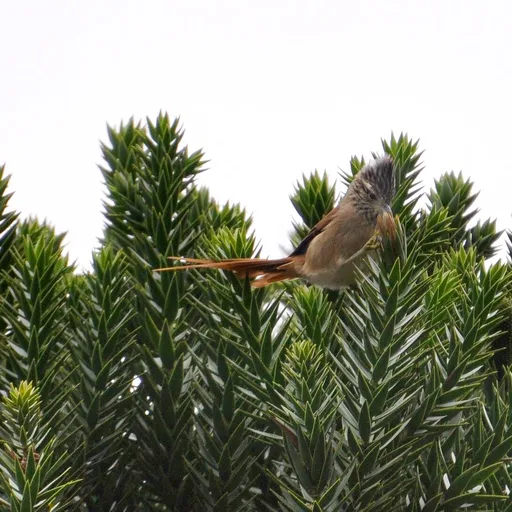
Araucaria Tit-Spinetail
Leptasthenura setaria
Least Concern
Overview
The Araucaria tit-spinetail (Leptasthenura setaria) is a small, long-tailed furnariid that is almost entirely dependent on Araucaria angustifolia trees for its survival. Found in parts of southern Brazil and northern Argentina, the species is currently classified as Near Threatened by the IUCN due to habitat loss and its specialised ecological requirements.
Identification
- 17–19 cm long with a small body, long forked tail, and short crest
- Blackish crown and crest with narrow paler streaks; reddish-brown upperparts with faint pale streaks on the upper back
- Thin white supercilium on a black-and-white striped face; brown or grey iris, blackish bill with a paler mandible base, and greyish-green legs
- Song consists of a series of very high, thin notes that shift in tempo between a trill and a rattle
Habitat
This bird is a year-round resident in Brazil from far southern Minas Gerais and Rio de Janeiro to Rio Grande do Sul, and west into Misiones Province in Argentina. It inhabits Araucaria angustifolia trees in a variety of landscapes, including forests, woodlands, scattered groves, gardens, and plantations, typically between 750 and 1,400 m but occasionally as high as 2,000 m.
Diet
The Araucaria tit-spinetail feeds on arthropods, foraging singly or in pairs almost exclusively in Araucaria angustifolia trees. It gleans prey from needles and branches between the mid-level and the canopy, sometimes hanging upside down to access its food.
Did you know?
The bird’s common name derives from its exclusive dependency on Araucaria angustifolia (the Brazilian pine); even in human-modified landscapes, it persists as long as these trees are not removed, despite the species' small range and decreasing population.
Sources
- Wikipedia · CC BY-SA 4.0
- Wikidata · CC0 1.0