
Black Sunbird
Leptocoma aspasia
Least Concern
Overview
The black sunbird (Leptocoma aspasia) is a small songbird belonging to the family Nectariniidae. It is currently listed as Least Concern on the IUCN Red List. Its lifespan is approximately 3.6 years.
Identification
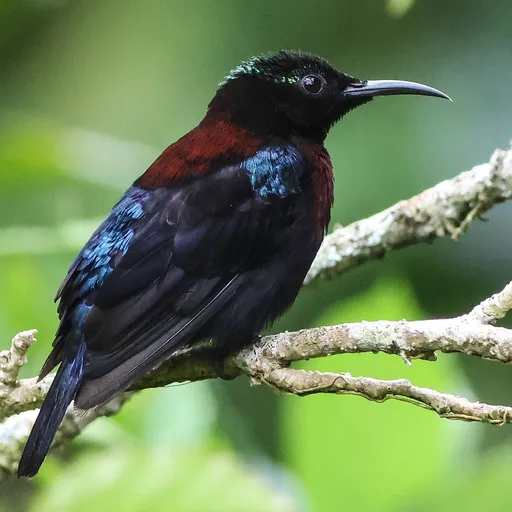
- Males are midnight black with an iridescent blue-purple chest stripe, a lustrous green crown, and blue-glossed wings and tail; the throat is reddish-purple, shifting to bluish in northern regions.
- Females are dusted greenish-yellow on the body with brown wings and head, appearing nondescript in northern areas with a charcoal head and olive-green upper body.
- Juveniles resemble females but possess a distinct yellow throat.
- The bill is long and down-curved, and the song consists of rapid, sweet cadences lasting 1.5 to 4 seconds, including high-pitched sibilant notes and rapid fire double notes.
Habitat
Found in eastern Indonesia and New Guinea, this species inhabits subtropical or tropical moist lowland forests and mangrove forests. It prefers a variety of forest types, especially at the forest edge, and is common in coconut plantations, shrubs, and gardens.
Diet
The bird forages for arthropods, fruit, and nectar from flowers and trees, obtaining most of its food by gleaning or hover-gleaning. It is very active during foraging and is usually found alone, in pairs, or in family groups, rarely joining mixed-species flocks.
Did you know?
The species was previously placed in the genus Nectarinia before being revised to its current classification in 2016.
Sources
- Wikipedia · CC BY-SA 4.0
- Wikidata · CC0 1.0