
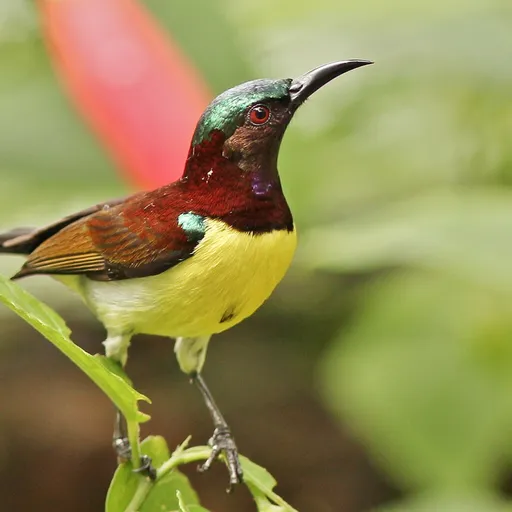
Purple-rumped Sunbird
Leptocoma zeylonica
Least Concern
Overview
The purple-rumped sunbird (Leptocoma zeylonica) is a small nectar-feeding bird endemic to the Indian Subcontinent. It is a common resident breeder found across a range of habitats, from scrubland to cultivated areas, and is classified as Least Concern on the IUCN Red List.
Identification
- Tiny in size, measuring less than 10 centimetres in length, with a medium-length thin down-curved bill and reddish irises.
- Males feature a dark maroon upperside with a blue-green crown, bright green shoulder patches, and a hidden violet rump; underparts are whitish with a dark throat, maroon breast band, and a violet throat patch.
- Females are olive above with yellow to buff underparts, a white throat, and black uppertail coverts, often displaying a weak supercilium.
- Calls consist of sharp twittering sounds such as 'ptsiee ptsit, ptsiee ptsswit' or 'tityou, titou, trrrtit'.
Habitat
Found in southern India, Sri Lanka, and Bangladesh, with a range extending from Gujarat to Assam or Meghalaya. The species inhabits a variety of environments containing trees, including scrub and cultivation, but is typically absent from dense forest. It is a common resident throughout the year.
Diet
Feeds primarily on nectar, often perching to lap from flowers rather than hovering, and occasionally consumes insects, particularly when feeding young. It pollinates several plant species but may engage in 'nectar theft' by piercing the base of deep flowers. The bird also visits open crop fields to consume honeydew exuded by leafhoppers.
Did you know?
These birds maintain special scratching posts where they remove pollen and nectar adhering to their heads. While collecting cobwebs for their nests, they are often seen tapping windows, likely responding to their own reflections.
Sources
- Wikipedia · CC BY-SA 4.0
- Wikidata · CC0 1.0