
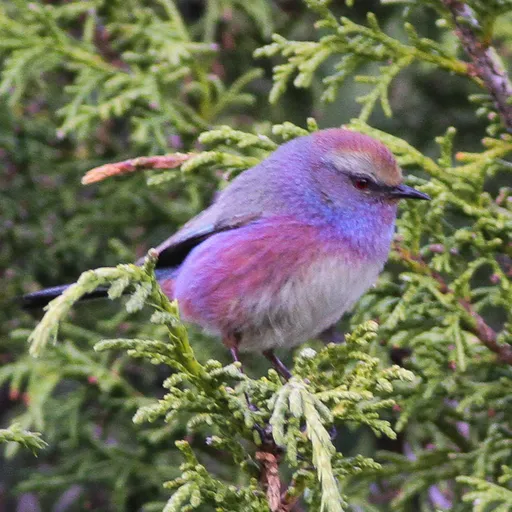
White-browed Tit-warbler
Leptopoecile sophiae
Least Concern
Overview
The white-browed tit-warbler (Leptopoecile sophiae) is a small passerine bird in the bushtit family, first described in 1873. It is characterised by its vibrant plumage and high-altitude habitats, with four recognised subspecies across Central Asia and the Himalayas.
Identification
- Small bird measuring 8.5–10 cm in length and weighing 6–8 g, with a relatively long tail.
- Males display vibrant blue-mauve underparts, chest and violet-blue rump and upper tail-coverts, while females are duller with pale underparts.
- Both sexes possess a light brown crown and a prominent white supercilium (eyebrow).
- The nominate race and L. s. obscurus are distinguished by darker colouration, whereas L. s. major and L. s. stoliczkae have lighter plumage.
Habitat
This species prefers dry mountainous shrubland at altitudes between 2,000 and 5,000 m within the Himalayas, Tibetan Plateau, and Northwest China. It ranges from southeast Kazakhstan and northwest China to north Pakistan and central Nepal, often dispersing to lower elevations during winter. Populations in the Tian Shan belong to a 'Middle-mountainous forest steppe community' and may show seasonal influxes in areas like Karakoram National Park.
Diet
The diet consists chiefly of small insects and spiders, which are foraged mainly on the ground by vigorously searching under roots and rocks. Some insects are also caught in the air, while seeds and berries supplement the diet in colder months. Chicks are fed exclusively on insect matter.
Did you know?
The white-browed tit-warbler lacks the arteria ophthalmica externa, a specialised blood vessel that minimises heat loss in the skull of many cold-adapted songbirds, suggesting it employs other methods to survive its frigid environment. Additionally, rare instances of egg dumping and two females attending a single nest indicate possible cooperative breeding, a trait found in less than 1% of nests.
Sources
- Wikipedia · CC BY-SA 4.0
- Wikidata · CC0 1.0