
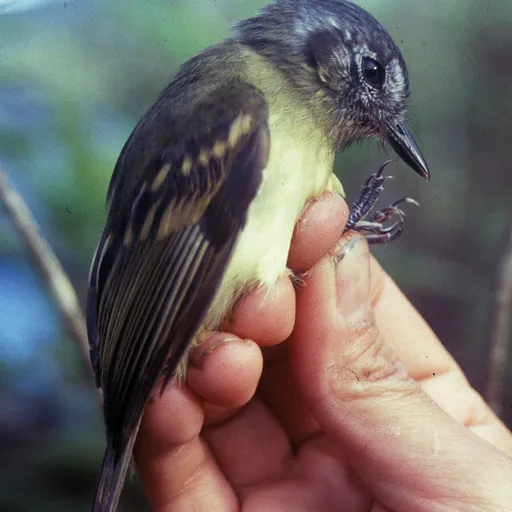
Slaty-capped Flycatcher
Leptopogon superciliaris
Least Concern
Listen
XC248565 · Niels Krabbe · Pichincha: ridge between Río Mindo and Río Nambillo, 3 km SE Mindo, Ecuador · CC BY-SA 4.0
Overview
The slaty-capped flycatcher (Leptopogon superciliaris) is a small passerine bird in the tyrant flycatcher family. It is a resident species found across a wide range in Central and South America, extending from Costa Rica to Bolivia and Venezuela.
Identification
- Measures 13 to 14 cm in length and weighs between 9.5 and 14.8 g.
- Adults of the nominate subspecies feature a slaty gray crown, white lores, and a thin white supercilium contrasting with a wide dusky crescent on the face.
- The back and rump are dark olive, while the breast is yellow with heavy, thin grayish olive streaking and the rest of the underparts are pale yellow.
- The bill is black, often with a pale orange or pinkish base to the mandible, and the legs are dark gray.
Habitat
This species inhabits humid foothill and montane evergreen forest, secondary forest, and coffee plantations in the upper tropical and subtropical zones. Its range spans from Costa Rica south to Bolivia and east to Venezuela and Trinidad, typically occurring at elevations between 200 and 2,100 m depending on the location.
Diet
The slaty-capped flycatcher primarily feeds on arthropods, supplemented by small fruits and berries. It forages in the middle to subcanopy levels, often sitting erect on a perch to hover-glean or snatch food from leaves in short sallies, and frequently joins mixed-species feeding flocks.
Did you know?
The nest is a ball of fibrous rootlets lined with seed down, suspended from a tendril or root and almost always built next to or over a stream in heavily shaded areas such as rock clefts or earthen banks.
Sources
- Wikipedia · CC BY-SA 4.0
- Wikidata · CC0 1.0