
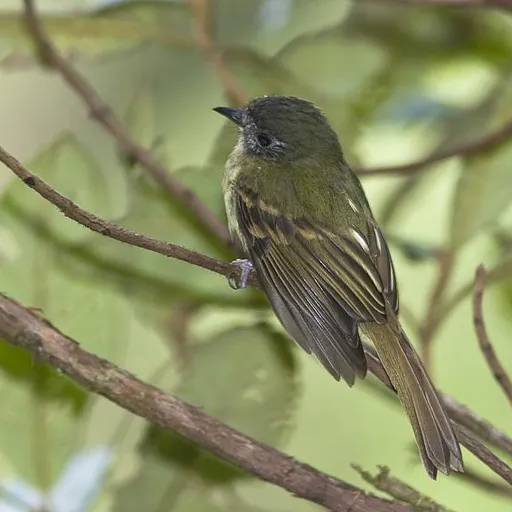
Inca Flycatcher
Leptopogon taczanowskii
Least Concern
Overview
The Inca flycatcher (Leptopogon taczanowskii) is a tyrant flycatcher that is endemic to Peru. This monotypic species is considered fairly common, though its estimated population is decreasing due to habitat loss.
Identification
- Size: 12 to 13.5 cm (4.7 to 5.3 in) in length.
- Plumage: Dark olive or brownish olive crown with a mottled blackish and whitish face featuring a thin whitish eye-ring; back and rump are olive green; underparts consist of a grayish chin and upper throat, tawny lower throat and breast, and pale olive yellow belly.
- Markings: Two wing bars formed by ochraceous tips on dusky wing coverts; wings are dusky with olivaceous edges on the flight feathers.
- Song: Described as a squeaky "skleew-di-wurdee?" with calls consisting of 1–5 "skleew" notes and sharp "pik" notes.
Habitat
Found on the east slope of the Peruvian Andes from the Marañón River south to Cuzco Department, the species inhabits the interior and edges of humid montane forest. It occupies elevations between 1,700 and 2,700 m (5,600 and 8,900 ft) as a year-round resident.
Diet
The diet consists mostly of arthropods and small fruits, foraged from the forest understory up to the middle level, usually within 3 m of the ground. The bird sits erect on a perch and uses short sallies to hover-glean or snatch prey, typically foraging singly, in pairs, or in mixed-species flocks.
Did you know?
The species was originally described in 1884 as Leptopogon rufipectus but was renamed Leptopogon taczanowskii in 1917 to resolve a nomenclature conflict with the rufous-breasted flycatcher.
Sources
- Wikipedia · CC BY-SA 4.0
- Wikidata · CC0 1.0