
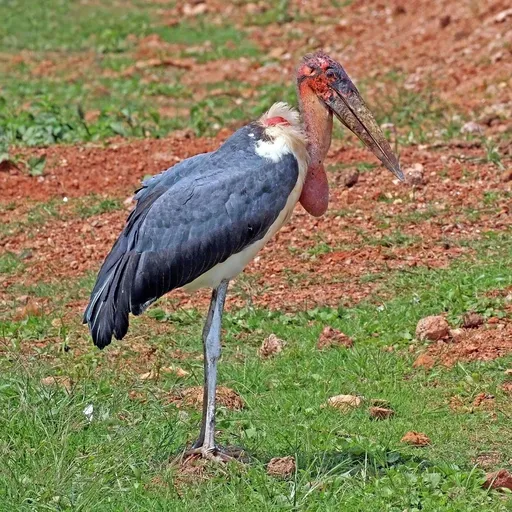
Marabou Stork
Leptoptilos crumenifer
Least Concern
Overview
The marabou stork (Leptoptilos crumenifer) is a large wading bird in the stork family Ciconiidae native to sub-Saharan Africa. It is often credited with having the largest wingspan of any land bird, averaging 2.6 metres and reaching up to 3.2 metres.
Identification
- Massive size with a wingspan typically between 225 and 287 cm, and a height reaching up to 152 cm.
- Unmistakable bare head and neck, contrasting with a black back and white underparts.
- Features a huge bill, a pink gular sac at the throat, a neck ruff, and white legs.
- Young birds are browner with a smaller bill, while full plumage maturity is not reached for up to four years.
Habitat
The species breeds in both wet and arid habitats, often near human habitation and landfill sites. In East Africa, they interact with humans and breed in urban areas, whereas in southern African countries, they breed mainly in less populated regions.
Diet
Marabou storks are frequent scavengers that eat mainly carrion, scraps, and faeces, but will opportunistically consume almost any animal matter they can swallow. They often follow vultures to steal meat or wait for leftovers, and increasingly depend on human garbage in urban areas.
Did you know?
The bird is sometimes called the "undertaker bird" due to its shape from behind, which resembles a cloak-like back and wings, skinny white legs, and sometimes a large white mass of "hair".
Sources
- Wikipedia · CC BY-SA 4.0
- Wikidata · CC0 1.0