
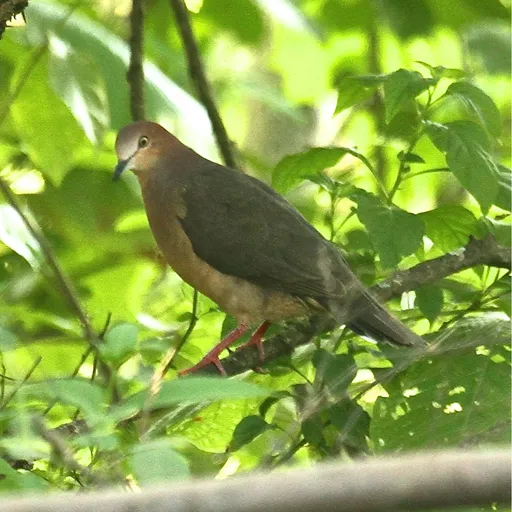
Ochre-bellied Dove
Leptotila ochraceiventris
Vulnerable
Overview
The ochre-bellied dove, also known as the buff-bellied dove (Leptotila ochraceiventris), is a species of bird in the family Columbidae found in Ecuador and Peru. Classified as Vulnerable by the IUCN, it has a small population that is believed to be declining due to habitat loss.
Identification
- A small dove measuring 23 to 25 cm long, featuring a whitish pink forehead, rusty purple crown, and iridescent purple hindneck.
- Upperparts are dark olive-brown with bronzy green or purple iridescence on the mantle, while the throat is white, breast is reddish, and the lower breast, flanks, and belly are buff.
- Possesses a yellow eye and inner tail feathers that are dark brown with outer ones being black with white tips.
- Produces a distinctive single slightly downslurred note described as 'wOOOooo', which has a clear emphasis at the beginning and gradually fades out.
Habitat
Found in the lowlands of western Ecuador and separately in the lowlands and Andes of southwestern Ecuador into northwestern Peru, this bird inhabits moist evergreen, semi-deciduous, and dry deciduous forests, as well as lower montane forest and humid cloudforest. It mostly ranges between 500 and 1,800 m in elevation but has been recorded as low as 80 m and as high as 2,625 m.
Diet
The ochre-bellied dove usually forages on the forest floor and up to 4 m above it. While its diet is not well known, it has been observed eating fruit plucked from trees.
Did you know?
Although its breeding phenology is almost unknown, observations of song activity and birds in breeding condition suggest it nests twice a year, between January and April and again in August and September.
Sources
- Wikipedia · CC BY-SA 4.0
- Wikidata · CC0 1.0