
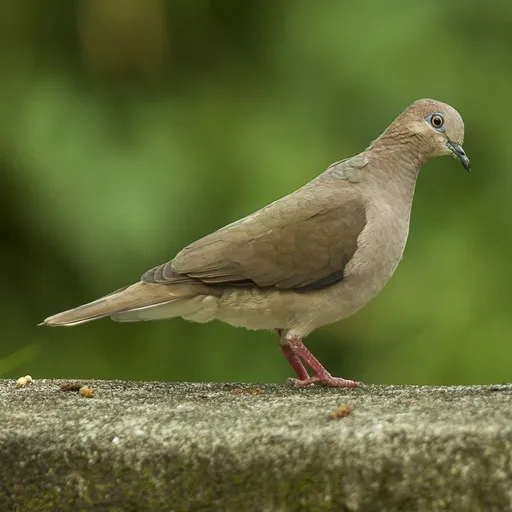
White-tipped Dove
Leptotila verreauxi
Least Concern
Listen
XC891586 · steve · Frontera Audubon Society (near Weslaco), Hidalgo County, Texas, United States · CC BY-SA 4.0
Overview
The white-tipped dove (Leptotila verreauxi) is a large New World tropical dove, classified as Least Concern on the IUCN Red List. Its scientific name commemorates the French naturalists Jules and Edouard Verreaux. This species is a resident breeder that does not migrate, typically observed alone or in pairs.
Identification
- About 28 cm long and weighing 155 g, with a black bill, red legs, and a yellow iris.
- Adults feature a greyish crown and nape contrasting with a pale grey or whitish forehead and throat.
- Upperparts and wings are grey-brown, while underparts are whitish, shading to pinkish, dull grey, or buff on the chest, with rufous underwing coverts.
- The tail is broadly tipped with white, most visible from below or in flight; the eye-ring is typically red, though blue in most of the Amazon and northern South America.
- The call is a deep, hollow ooo-wooooo, consisting of an introductory hoot followed by a longer, more audible hollow note.
Habitat
Found from southernmost Texas through Mexico and Central America to western Peru and central Argentina, as well as on offshore islands in northern South America. It inhabits scrub, woodland, and forest environments.
Diet
The dove primarily feeds on seeds, which it obtains by foraging on the ground. It will also consume insects, including butterflies and moths.
Did you know?
The white-tipped dove builds a large stick nest in a tree near ground level, laying two white eggs. It resembles the closely related grey-fronted dove but can be distinguished by its greyer forehead and crown, which contrast less with the hindcrown.
Sources
- Wikipedia · CC BY-SA 4.0
- Wikidata · CC0 1.0