
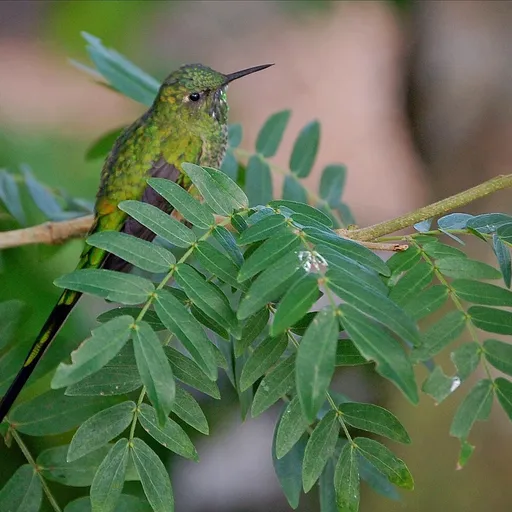
Green-tailed Trainbearer
Lesbia nuna
Least Concern
Overview
The green-tailed trainbearer (Lesbia nuna) is a species of hummingbird in the coquettes, tribe Lesbiini. It is classified by the IUCN as Least Concern due to its large range and stable population.
Identification
- Males of the nominate subspecies are almost entirely glittering emerald green with a long, forked black tail featuring green tips.
- Females have white underparts with glittering green spots and a shorter tail than males.
- The species weighs between 3.1 and 4.3 g, with males measuring 15.3 to 17 cm in length including the tail.
- The bill is short, straight, and black.
- The song consists of a repeated gravelly 'drrrt' note, while calls include a buzzy 'bzzzzt' or an accelerating series of high-pitched notes.
Habitat
Found in the Andes of Bolivia, Colombia, Ecuador, Peru, and possibly Venezuela, this bird inhabits secondary woodland, brushy slopes, Polylepis woodland, and páramo. It ranges in elevation from 1,700 to 3,800 m.
Diet
The green-tailed trainbearer forages for nectar at low to medium heights, visiting flowers such as Castilleja fissifolia, Cavendishia cordifolia, and Rubus. It also feeds on insects caught on the wing and gleaned from flowers.
Did you know?
The bird makes a distinct snapping sound with its tail or wings when displaying.
Sources
- Wikipedia · CC BY-SA 4.0
- Wikidata · CC0 1.0