
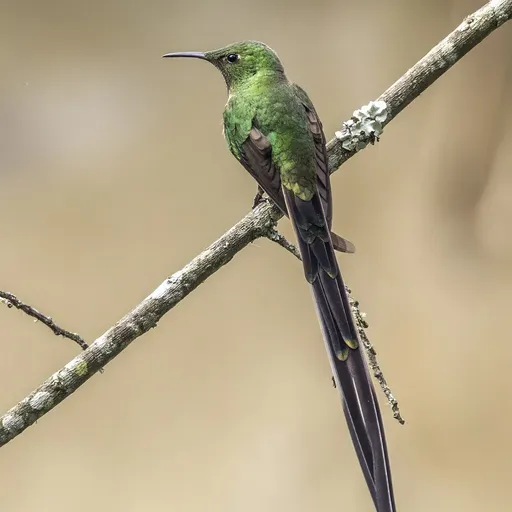
Black-tailed Trainbearer
Lesbia victoriae
Least Concern
Overview
The black-tailed trainbearer (Lesbia victoriae) is a species of hummingbird in the family Trochilidae found in the Andes of South America. It is classified as Least Concern by the IUCN due to its broad distribution and stable populations.
Identification
- Males measure 21 to 24 cm in length, featuring mostly green plumage, long black tail feathers, and an iridescent green chest and throat.
- Females are smaller (13.5 to 14.5 cm) with shorter tails and white underparts marked with green spots.
- The species possesses a longer, more decurved bill and a duller green overall appearance compared to the green-tailed trainbearer.
Habitat
Found in the central and northern Andes of Colombia, Ecuador, and Peru at altitudes between 2,500 and 3,800 meters, it inhabits subtropical or tropical moist montane forests, high-altitude shrubland, and degraded former forests. It prefers semi-open areas and can adapt well to urban ecosystems such as parks and gardens.
Diet
As a nectar generalist, this hummingbird forages on flowers of various sizes, mostly near the ground, and supplements its diet with small arthropods. It consumes a greater percentage of arthropods than species found at lower altitudes.
Did you know?
Males perform a courtship display that involves flying high to show off their tails, then diving while producing a clicking noise with them. Additionally, the birds incorporate synthetic fibers from human activity into their nests when available.
Sources
- Wikipedia · CC BY-SA 4.0
- Wikidata · CC0 1.0