
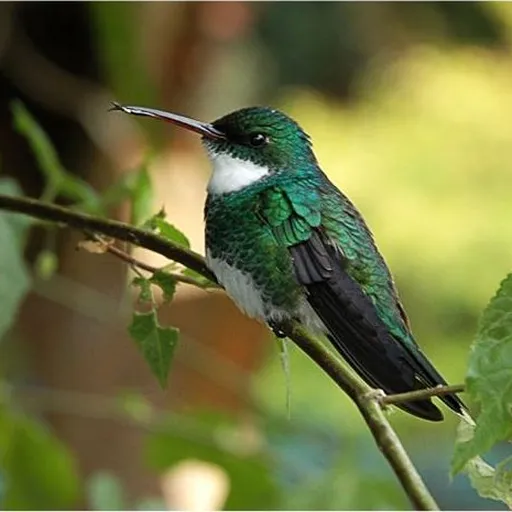
White-throated Hummingbird
Leucochloris albicollis
Least Concern
Overview
The white-throated hummingbird (Leucochloris albicollis) is the sole member of its genus and belongs to the tribe Trochilini. It is a small, mostly sedentary species found across parts of South America. The species is currently assessed as Least Concern by the IUCN.
Identification
- Length ranges from 10 to 11.5 cm, with males weighing 5 to 8 g and females approximately 4.5 g.
- Males feature golden- to bronze-green upperparts and a white throat, while females appear duller and less glittery.
- The bill is medium-length and straight, with a blackish maxilla and a red mandible tipped in black.
- Song consists of a series of 4–10 high-pitched, buzzy notes emphasising the first note, described as 'bzeeeee-bzee-bzee-bzee-bzee'.
Habitat
Found in eastern Paraguay, southeastern Brazil, Uruguay, and northeastern Argentina, it inhabits semi-open to open landscapes such as forest edges, marshes, scrublands, parks, and gardens. Elevation typically ranges from near sea level to 1,000 m, though occasional records exist up to 2,100 m.
Diet
This species forages for nectar from a wide variety of native and introduced plants, with a particular preference for Bromeliaceae. It also feeds on insects captured by hawking from a perch.
Did you know?
The species name albicollis derives from the Latin words albus meaning 'white' and collum meaning 'neck', referencing its distinctive white throat. It is the only species in its genus Leucochloris and has no recognised subspecies.
Sources
- Wikipedia · CC BY-SA 4.0
- Wikidata · CC0 1.0