
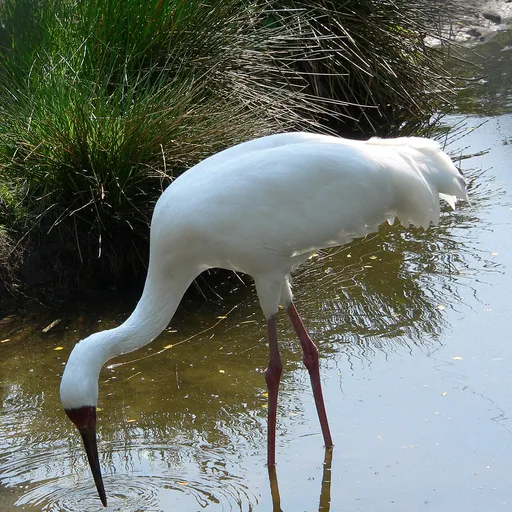
Siberian Crane
Leucogeranus leucogeranus
Critically Endangered
Listen
XC834523 · Ana Rivas · Khurkh Valley, Khentii, Mongolia · CC0 1.0
Overview
The Siberian crane (Leucogeranus leucogeranus), also known as the Siberian white crane or snow crane, is a species of crane that makes some of the longest migrations of any bird. It is currently classified as Critically Endangered by the IUCN, with a global population estimated at approximately 5,500 individuals in 2024.
Identification
- Adults are nearly all snowy white, except for black primary feathers visible in flight, with a bare brick-red fore-crown, face, and sides of the head.
- The bill is dark and the legs are pinkish, while the iris is yellowish.
- A fairly large species, standing about 140 cm tall with a wingspan of 210 to 260 cm, though typically slightly smaller than the sarus or red-crowned crane.
- The call is a goose-like, high-pitched whistling 'toyoya', distinct from the trumpeting of most other cranes.
Habitat
This species inhabits shallow marshlands and wetlands in the Arctic tundra of western and eastern Russia, where it breeds in two disjunct populations. The eastern population migrates to winter in China, primarily at Poyang Lake, while the western population winters in Iran.
Diet
Omnivorous with a tendency towards plant matter, feeding on roots, seeds, earthworms, fish, and small rodents like lemmings in summer, and submerged vegetation such as Vallisneria spiralis in winter. They often immerse their heads entirely underwater when feeding on submerged vegetation and swallow pebbles to aid digestion.
Did you know?
Among cranes, the Siberian crane makes the longest distance migrations, and in captivity, one individual was recorded living for nearly 62 years while another lived for 83 years.
Sources
- Wikipedia · CC BY-SA 4.0
- Wikidata · CC0 1.0