
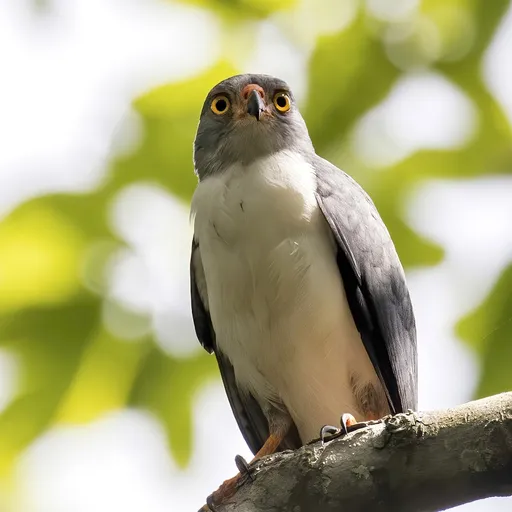
Semiplumbeous Hawk
Leucopternis semiplumbeus
Least Concern
Listen
XC251066 · Niels Krabbe · Pichincha: Río Guaycuyacu, Ecuador · CC BY-SA 4.0
Overview
The semiplumbeous hawk (Leucopternis semiplumbeus) is a small bird of prey found in Central and South America. It inhabits humid subtropical and tropical lowland forests and is classified as Least Concern, although its population is declining.
Identification
- Small hawk averaging 30–33 cm in length, similar in size to a kestrel or merlin.
- Dark grey upperparts contrasting with white underparts and a white throat.
- Distinctive features include a striking orange cere, a black face mask, and bright yellow eyes.
- Legs and feet are orange to orange-red in colour.
- During the breeding season, it produces loud, piercing upslurred whistles sounding like "kwee...wee...wee...wee...wee."
Habitat
Found in eastern Honduras, eastern Nicaragua, western Colombia, and north-west Ecuador, with recent reports in northern Peru potentially referring to this or a related species. It occupies humid forests in tropical and lower subtropical zones, including forest edges, fragments, and tall second-growth areas. Typically found below 500 m, though it has been recorded up to 1,600 m.
Diet
Employing a sit-and-wait strategy, it perches silently on high branches to ambush prey. It frequently follows swarms of army ants to capture antbirds, which form a large portion of its diet alongside other small songbirds. It may also feed on bats, lizards, and snakes.
Did you know?
Despite being listed as Least Concern, the species has a small and declining population estimated at only 1,000 to 10,000 mature individuals, largely due to deforestation and habitat fragmentation.
Sources
- Wikipedia · CC BY-SA 4.0
- Wikidata · CC0 1.0