
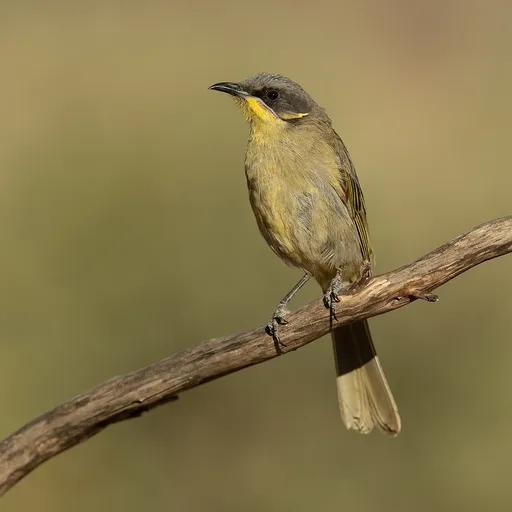
Purple-gaped Honeyeater
Lichenostomus cratitius
Least Concern
Overview
The purple-gaped honeyeater (Lichenostomus cratitius) is a medium-sized bird species in the family Meliphagidae, endemic to semi-arid southern Australia. It is also known as the wattle-cheeked honeyeater in some references.
Identification
- Plumage is generally grey-olive above and buffish yellow below, with a patterned head featuring a black eyestripe, purple gape, yellow throat streak, and pointed yellow ear coverts.
- Medium-sized at 16-19 cm, with the Kangaroo Island subspecies being larger and darker than mainland birds.
- Song consists of a clear 'toweet-toweet-toweet' followed by a high-pitched 'yep-yep-yep', often performed from tall branches.
- Juveniles have duller facial patterns, slightly browner plumage, and a yellow gape and gape line.
Habitat
Primarily inhabits mallee woodland and shrubland, including bull mallee and patches of green or blue mallee, as well as yellow gum woodland with dense thickets of totem-poles or violet honey-myrtle. The species occurs in disjunct populations across southern Australia, east from southern Western Australia, with the eastern population largely south of the Murray River and NSW marking the extreme north-east of its range.
Diet
Feeds mainly on nectar and insects, especially from flowering mallee eucalypts and banksias, and also forages for insects under loose bark on trunks and branches or catches flying insects on the wing. Less frequently consumes seeds, pollen, and honeydew from scale insects.
Did you know?
Despite having naturally disjunct populations across its range, the purple-gaped honeyeater exhibits very low genetic diversity, indicating limited genetic variation across its entire distribution.
Sources
- Wikipedia · CC BY-SA 4.0
- Wikidata · CC0 1.0