
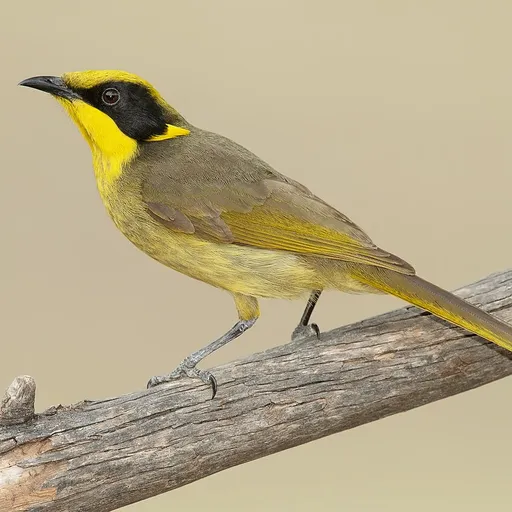
Yellow-tufted Honeyeater
Lichenostomus melanops
Least Concern
Overview
The yellow-tufted honeyeater (Lichenostomus melanops) is a passerine bird found in the south-east ranges of Australia. It is a predominantly black and yellow species that is split into four subspecies.
Identification
- 17–23 cm long, with females usually smaller than males.
- Bright yellow forehead, crown and throat contrasting with a glossy black mask and bright golden ear-tufts.
- Olive-green to olive-brown back and wings, with more olive-yellow underparts.
- Black bill and gape, brown eyes, and grey-brown legs.
Habitat
The species occurs from south-east Queensland through eastern New South Wales and across Victoria. It prefers dry open sclerophyll forests and woodlands dominated by eucalypts with shrubby undergrowth, as well as mallee, brigalow and cypress-pine. The helmeted honeyeater subspecies is largely restricted to dense vegetation along riverbanks dominated by mountain swamp gum.
Diet
Primarily arthropods such as a variety of insects and spiders, occasionally snails, and also lerps and honeydew, nectar and sap flows from eucalypts, plus occasional fruit and flowers. It takes insects in flight and by probing the bark of tree-trunks and limbs.
Did you know?
The helmeted honeyeater subspecies, which is the brightest and largest, is restricted to a 5 km length of remnant bushland along two streams in the Yellingbo Nature Conservation Reserve. In 2003, there were only 103 individuals in the wild with 20 breeding pairs known.
Sources
- Wikipedia · CC BY-SA 4.0
- Wikidata · CC0 1.0