
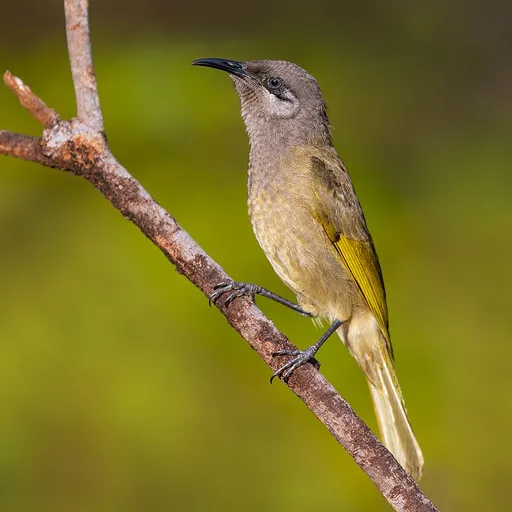
Grey-eared Honeyeater
Lichmera incana
Least Concern
Overview
The grey-eared honeyeater (Lichmera incana), also known as the dark-brown or silver-eared honeyeater, is a passerine bird found in Vanuatu and New Caledonia in the south-west Pacific. Classified as Least Concern on the IUCN Red List, it is a common species across most of its range.
Identification
- Size ranges from 13 to 17 cm, with males typically larger than females.
- Plumage is dull green-brown above and grey with an olive tint below, featuring a dark grey crown and silvery-grey cheeks in adults.
- Possesses a long, slightly downcurved black bill and blue-grey legs and feet.
- Noisy vocalisations include a harsh tchoo-tchoo-tchoo call and a warbling song, often heard before dawn.
Habitat
Found in the lowlands and low hills of Vanuatu and New Caledonia, this species inhabits a variety of environments including forest, scrub, mangroves, and gardens. Five subspecies are recognised, with the nominate subspecies found on Grande Terre and others distributed across the Loyalty Islands and Vanuatu.
Diet
Feeding from the shrub layer up to the canopy, these birds move branch to branch to extract nectar and pollen from flowers. They also consume insects and spiders, which they search for among leaves, catch in short flights, or obtain by hovering in front of spider webs.
Did you know?
The nest is constructed from grass and plant fibres that are held together by spider webs. The breeding season typically lasts from October to February, with a 14-day incubation period for two eggs.
Sources
- Wikipedia · CC BY-SA 4.0
- Wikidata · CC0 1.0