
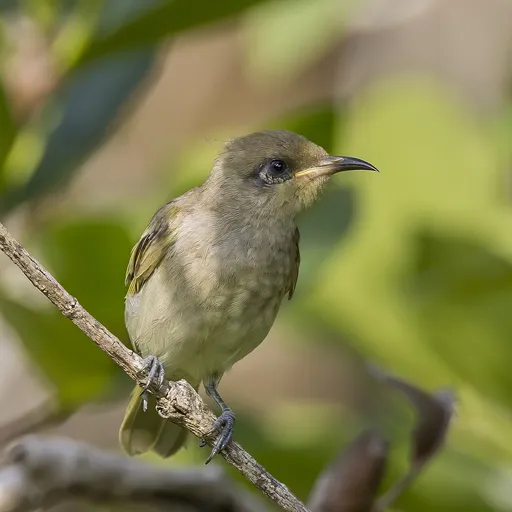
Brown Honeyeater
Lichmera indistincta
Least Concern
Listen
XC499417 · Peter Russell · Burrup, Shire of Roebourne, Western Australia, Australia · CC BY-SA 4.0
Overview
The brown honeyeater is a medium-small, plain grey-brown bird in the family Meliphagidae, characterised by its highly developed brush-tipped tongue adapted for nectar feeding. It is widespread across Australia, New Guinea, and parts of Indonesia, and is unique among honeyeaters for its presence on the island of Bali, making it the only member of its group west of the Wallace Line.
Identification
- Medium-small, plain grey-brown plumage with a small yellow patch behind the eye and dull yellow-olive panels in the folded wings and tail.
- A long, slender, black bill that is curved slightly downwards, well adapted for probing deep tubular flowers.
- A loud, clear, and musical song described as superior among honeyeaters, rendered as sweet-sweet-quarty-quarty, accompanied by a harsh alarm call of ke-ke.
Habitat
Found in a wide range of wooded habitats including mangroves, eucalypt woodlands, sclerophyll forests, and shrublands along watercourses in arid inland areas. The species is seasonally nomadic within its local area, following flowering food plants, and visits flowering shrubs in parks and gardens.
Diet
The brown honeyeater feeds primarily on nectar from trees such as mistletoe, mangroves, Banksia, and Grevillea, as well as insects gleaned from leaves or bark. It forages mainly in the canopy, often hovering over flowers or perching on stems, and may join small groups or mixed-species flocks with other honeyeater species.
Did you know?
Despite its plain and nondescript appearance, the brown honeyeater is widely regarded as the best songster among Australian honeyeaters, with its clear, rolling, and musical call described as having no superior in the family.
Sources
- Wikipedia · CC BY-SA 4.0
- Wikidata · CC0 1.0