
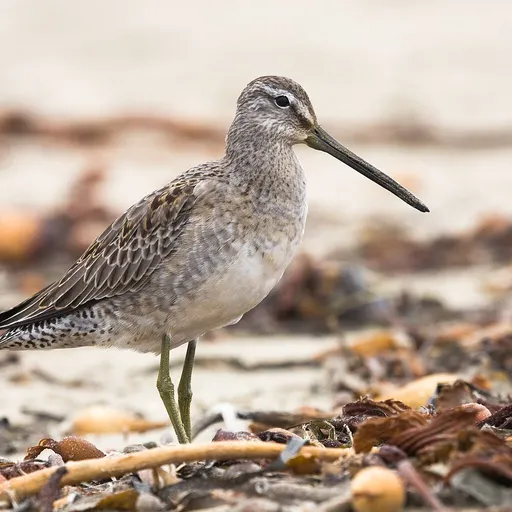
Long-billed Dowitcher
Limnodromus scolopaceus
Near Threatened
Overview
The long-billed dowitcher is a medium-sized shorebird in the sandpiper family that prefers freshwater habitats and is classified as Near Threatened. It was recognized as a separate species from the short-billed dowitcher in 1950, having been confused with it for much of the 20th century.
Identification
- Breeding plumage: Adults feature a rufous head and underparts, a dark crown, and a mottled brown back, with a large white upper rump visible in flight.
- Non-breeding plumage: Adults appear drab grey with darker upperparts and a contrasting pale white belly; they are visually very similar to short-billed dowitchers in winter.
- Bill: Very straight and black, becoming yellowish olive-green near the base, with a length of 62–72 mm (approximately twice the length of the head).
- Voice: Highly vocal, emitting a high, sharp keek that may accelerate into quick double or triple notes, or a common tu call, particularly when in feeding flocks.
Habitat
Breeding populations are found in northern Alaska and eastern Siberia, favouring wet grass or sedge meadows in freshwater environments. During the non-breeding season, they winter along the Pacific and Atlantic coasts of North America, moving inland to regions such as Arizona, Texas, and the Gulf Coast. They generally prefer fresh over salt water and muddy over sandy habitats, often foraging in water less than three inches deep.
Diet
They forage by jabbing or probing with a 'sewing machine' motion, using tactile receptors on the tip of their bill to locate prey by touch. While breeding, their diet consists largely of chironomidae larvae and other insects with occasional plant matter; in winter and during migration, they consume a broader range including polychaetes, crustaceans, and mollusks. They also utilise night vision to forage at night during migration.
Did you know?
Males perform a dramatic mating display that involves chasing females in flight, showcasing aerial speed and agility before singing while hovering 15 feet in the air above their territories. Their scientific name, Limnodromus scolopaceus, derives from Greek and Latin roots meaning 'marsh racer' and 'snipe-like' respectively.
Sources
- Wikipedia · CC BY-SA 4.0
- Wikidata · CC0 1.0