
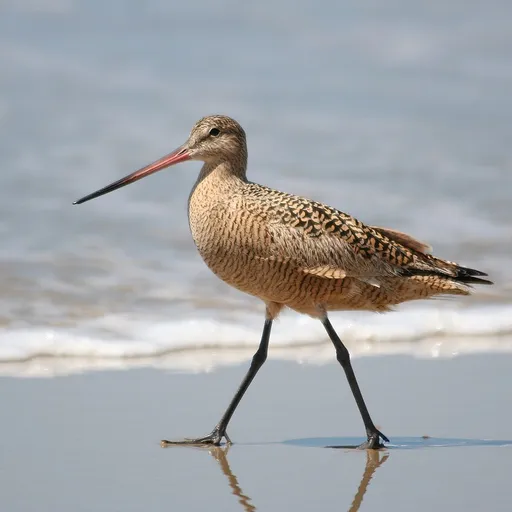
Marbled Godwit
Limosa fedoa
Vulnerable
Overview
The marbled godwit (Limosa fedoa) is a large migratory shorebird and the largest of the four species in its group. It is currently classified as Vulnerable on the IUCN Red List.
Identification
- Body length ranges from 40–50 cm with a wingspan of 70–88 cm.
- Features a very long pink bill, 8–13 cm in length, that is slightly upward-curved and dark at the tip.
- Long blue-grey legs and a pale brown neck, breast, and belly marked with dark bars.
- Mottled dark back displaying cinnamon wing linings in flight.
Habitat
Breeding grounds include mid-continental North America, eastern Canada, and the Alaska Peninsula, while wintering areas cover the Atlantic, Pacific, and Gulf coasts of the US and Mexico. Migration routes involve key stopover sites such as the Bear River Migratory Bird Refuge at Great Salt Lake in Utah.
Diet
These birds forage by probing in mudflats, marshes, or beaches primarily when the tide is out. Their diet mainly consists of insects and crustaceans, along with parts of aquatic plants, and they may pick up insects by sight in short grass.
Did you know?
Satellite tracking data from Alberta indicates that male and female godwits from the same breeding population migrate and winter separately, with females heading to the California coast and males wintering in Baja California Sur.
Sources
- Wikipedia · CC BY-SA 4.0
- Wikidata · CC0 1.0