
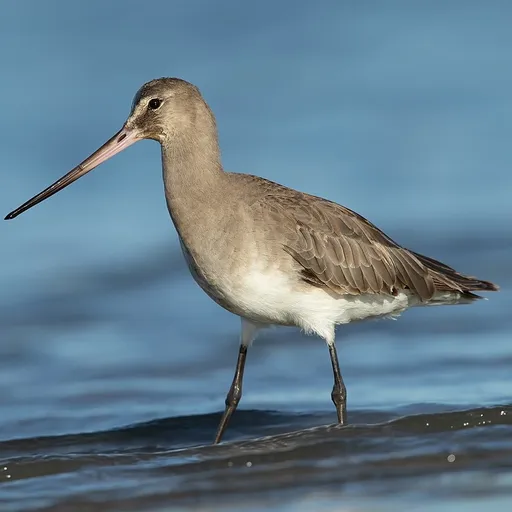
Hudsonian Godwit
Limosa haemastica
Vulnerable
Overview
The Hudsonian godwit (Limosa haemastica) is a large, sexually dimorphic shorebird in the sandpiper family that serves as a model for migration biology research. It is an extreme long-distance migrant that breeds in Subarctic North America and winters in southern South America. The species is currently classified as Vulnerable by the IUCN due to its fragmented distribution and small population.
Identification
- Long, slender legs that are bluish-grey in colour.
- A long, pink bill with a slight upward curve that is dark at the tip.
- Mottled brown upperparts and chestnut underparts, with a white rump and black tail.
- Black wing linings visible in flight.
- Females are generally heavier than males.
Habitat
Breeding occurs in disjunct localities across subarctic Canada and Alaska, primarily at the interface between wetlands such as sedge meadows and forested areas. The species undertakes a looped migration, with a rapid, direct southbound route over the Atlantic to winter on sheltered tidal mudflats in the Southern Cone. Wintering populations are concentrated on Tierra del Fuego and the Pacific coast of Chile.
Diet
These birds forage by probing in shallow water for invertebrates and plant material. During migration, they utilise a variety of wet habitats including rice fields, sewage ponds, natural marshes, and mudflats.
Did you know?
The English name 'godwit' is believed to imitate the bird's call, a usage first recorded around 1416–17.
Sources
- Wikipedia · CC BY-SA 4.0
- Wikidata · CC0 1.0