
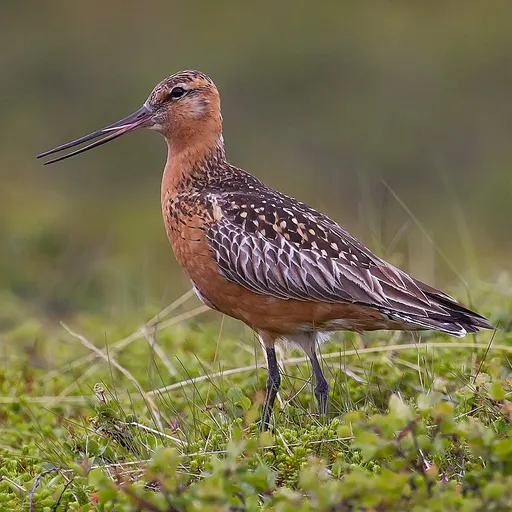
Bar-tailed Godwit
Limosa lapponica
Near Threatened
Listen
XC1107762 · Sonothèque ADVL · Genêts, Manche, Normandy, France · CC0 1.0
Overview
The bar-tailed godwit (Limosa lapponica) is a large, strongly migratory wader that feeds on bristle-worms and shellfish in coastal mudflats and estuaries. It breeds on Arctic coasts and tundra ranging from Scandinavia to Alaska, and overwinters on coasts in temperate and tropical regions of Australia and New Zealand. The species is currently classified as Near Threatened on the IUCN Red List.
Identification
- Adult breeding plumage features unbroken brick red on the neck, breast, and belly, with dark brown upperparts; non-breeding plumage is plain grey-brown with darker feather centres and whitish underparts.
- Distinguished by a long, tapering, slightly upturned bill that is pink at the base and black towards the tip, along with blue-grey legs.
- The tail and upper tail coverts are horizontally barred black and white, distinguishing it from the wholly black-tailed Black-tailed Godwit.
- Body size ranges from 37–41 cm in length with a wingspan of 70–80 cm, exhibiting sexual dimorphism where females are generally larger than males.
Habitat
This species inhabits Arctic coasts and tundra for breeding and coastal mudflats and estuaries for feeding and wintering. Its range extends from northern Scandinavia and Siberia to Alaska in the north, and to Australia, New Zealand, and parts of Europe and Africa in the south.
Diet
Bar-tailed godwits primarily consume bristle-worms, supplemented by small bivalves, crustaceans, and invertebrates. They forage by picking items from the surface while walking or probing and twisting their bills in matted vegetation to extract deeply buried prey. Males and females employ different feeding strategies, with males often targeting smaller surface prey and females consuming deeper-buried items.
Did you know?
The migration of the Limosa lapponica baueri subspecies across the Pacific Ocean from Alaska to New Zealand is the longest known non-stop flight of any bird, as well as the longest journey without pausing to feed by any animal. A specific female tracked in 2007 completed a round-trip migration of over 29,280 km in just 174 days.
Sources
- Wikipedia · CC BY-SA 4.0
- Wikidata · CC0 1.0