
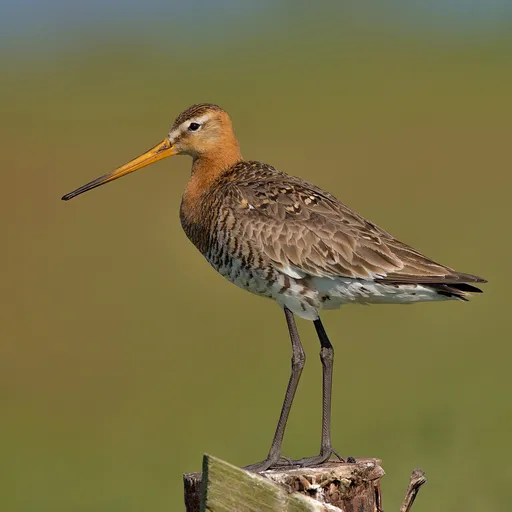
Black-tailed Godwit
Limosa limosa
Near Threatened
Listen
XC707060 · Sonothèque ADVL · Genêts, Manche, Normandie, France · CC0 1.0
Overview
The black-tailed godwit (Limosa limosa) is a large, long-legged shorebird belonging to the godwit genus. It was first described by Carl Linnaeus in 1758 and is currently classified as Near Threatened by the IUCN Red List. The species comprises four subspecies that exhibit distinct seasonal plumage changes.
Identification
- A large wader measuring 42 cm from bill to tail with a wingspan of 70–82 cm, featuring a long bill (7.5 to 12 cm), long neck, and dark grey, brown or black legs.
- In breeding plumage, the head, neck and chest are orange, with males displaying brighter and more extensive orange colouring; winter plumage is dull grey-brown and uniform.
- Possesses a distinctive black and white wingbar visible at all times, along with bold black and white wings and a white rump in flight.
- The most common call is a strident 'weeka weeka weeka'.
Habitat
Breeding occurs across a discontinuous range from Iceland to the far east of Russia in river valley fens, lake edges, damp steppes, raised bogs and moorlands. During winter, the species migrates to diverse locations including the Indian subcontinent, Australia, New Zealand, western Europe and west Africa, utilising estuaries, swamps, floods and inland wetlands. It is generally more likely to be found on inland wetlands and freshwater areas than the similar bar-tailed godwit.
Diet
The bird mainly eats invertebrates such as beetles, flies, grasshoppers, dragonflies, mayflies, caterpillars, annelid worms and molluscs, occasionally consuming fish eggs, frogspawn and tadpoles during the breeding season. In winter and on migration, it also consumes aquatic plants. Feeding methods include vigorous probing in water, up to 36 times per minute with the head completely submerged, and picking prey from the surface or probing soft ground on land.
Did you know?
The oldest recorded black-tailed godwit is 29 years and 2 months old, an Icelandic subspecies that was colour-ringed as a juvenile in Lincolnshire, England in 1996 and has subsequently been observed on 91 separate occasions.
Sources
- Wikipedia · CC BY-SA 4.0
- Wikidata · CC0 1.0