
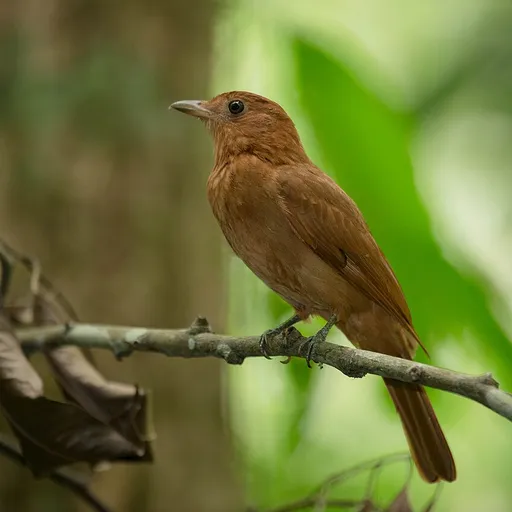
Rufous Piha
Lipaugus unirufus
Least Concern
Listen
XC248216 · Niels Krabbe · Esmeraldas: 18.5 road km NNW Alto Tambo, Ecuador · CC BY-SA 4.0
Overview
The rufous piha (Lipaugus unirufus) is a species of bird in the family Cotingidae. It is a year-round resident classified as Least Concern by the IUCN, with an estimated population of at least 50,000 mature individuals that is currently decreasing.
Identification
- Length of 22 to 26 cm with a weight range of 79 to 97 g.
- Plumage features a rufous crown with thin, lighter streaks on the nominate subspecies, deep cinnamon brown upperparts and underparts, and dark brown irises.
- Bill has a dusky gray maxilla and a dull buffy brown mandible with a gray tip; legs are gray to brown.
- Vocalisations are loud and explosive, described as scratchy, electric-sounding calls such as 'WIIII'WERRRE!' or 'peeuuurr' for the nominate, and whistled calls like 'peeeéuw' for the castaneotinctus subspecies.
Habitat
The species primarily inhabits humid evergreen forest and mature secondary forest in the lowlands of the tropical zone, occasionally occurring in more open areas with scattered trees. Its range extends from southern Mexico throughout Central America, the Chocó-Magdalena region, and into western and northwestern Ecuador. Elevation preferences vary by region, ranging from sea level to 700 m in Ecuador and up to 1,500 m in Colombia.
Diet
The rufous piha feeds on a variety of insects, arthropods such as spiders, berries, and fruits from palms and laurels. It typically forages singly or in small loose flocks, perching in the mid-story to canopy before making short flights to catch prey in a brief hover.
Did you know?
The species is polygynous, with males courting females in a loose lek or attracting them individually with calls. The nest is a shallow cup made of twigs, vines, and plant fibres, usually placed on horizontal branches 5 to 10 m above the ground.
Sources
- Wikipedia · CC BY-SA 4.0
- Wikidata · CC0 1.0