
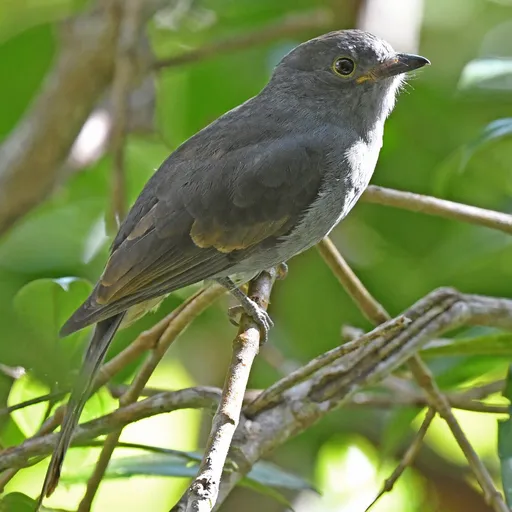
Chestnut-capped Piha
Lipaugus weberi
Critically Endangered
Overview
The chestnut-capped piha (Lipaugus weberi) is a species of bird in the family Cotingidae that is endemic to a small portion of the central Andes in Colombia. It is classified as critically endangered by the IUCN, with a remaining population estimated to be as low as 250 individuals. The species is known for its extremely restricted habitat and significant population decline due to habitat destruction.
Identification
- Dark grey passerine, approximately 20 to 25 cm long, featuring a notable chestnut crown on the upper nape and pale cinnamon-colored undertail coverts.
- Distinctive bright yellow orbital ring and dark brown iris, with a black bill that is relatively deep and broad at the base with a very hooked tip.
- Legs and feet are dark grey with contrasting yellow soles, and the tail is noticeably long and forked.
- Extremely loud, piercing call described as 'sreeck' that rises in pitch before abruptly descending, audible over 100 m; males can also produce a whirring noise with modified primary feathers.
Habitat
The species is restricted to a narrow band of extremely humid premontane cloud forest between 1,400 and 1,925 m elevation in the northern slope of the Cordillera Central mountains in the department of Antioquia, Colombia. It prefers pristine cloud forest and is non-migratory. Sixteen distinct populations are known from this area east of the Nechí River Valley, near the towns of Amalfi and Anorí.
Diet
Mostly frugivorous, consuming small to medium-sized fruits from various plant families, with a particular preference for laurels. The bird typically forages by hover-gleaning on short sallying flights, though it occasionally eats from a perched position or bashes larger fruits against a branch. It also consumes some invertebrates.
Did you know?
Locals call the species 'Arrierito Antioqueño', translating to 'little herdsman of Antioquia', because its call resembles the whistles made by horsemen herding cattle. The bird was not discovered until 1999, remaining unknown to science due to political instability in the region.
Sources
- Wikipedia · CC BY-SA 4.0
- Wikidata · CC0 1.0