
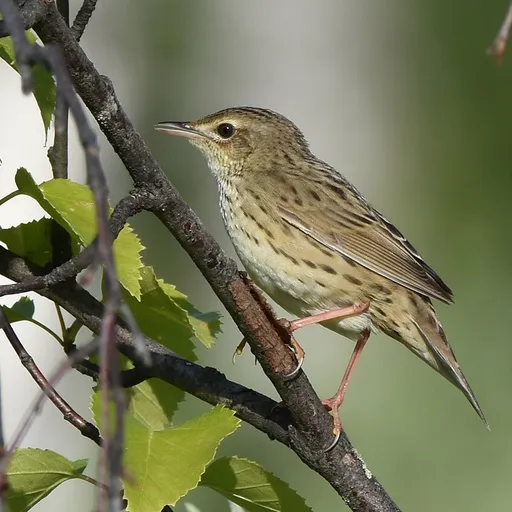
Lanceolated Warbler
Locustella lanceolata
Least Concern
Overview
The lanceolated warbler, Locustella lanceolata, is a small passerine bird classified as a species of Old World warbler in the genus Locustella. This migratory species breeds across the Palearctic from northwestern European Russia to northern Hokkaidō, Japan, and winters in Southeast Asia.
Identification
- Small warbler with a streaked brown back and whitish grey underparts featuring small lance-shaped streaks that also appear on the undertail.
- Adult plumage is identical in both sexes, while young birds appear yellower below.
- Song consists of a monotonous, mechanical, insect-like reeling sound, often given at dusk.
- Described as a skulking species that is very difficult to see, usually observed only when singing while creeping through grass and low foliage.
Habitat
Found in grassland with some thicker shrubby vegetation or trees, often close to water in bogs or wet clearings. The breeding range extends from northwestern European Russia across the Palearctic to northern Hokkaidō, Japan, with the species being a rare vagrant to western Europe.
Diet
This species is insectivorous like most warblers, though specific foraging techniques are not detailed beyond the observation that it creeps through grass and low foliage.
Did you know?
The specific name lanceolata is Latin for "spear-shaped", directly referring to the distinctive streaks on the bird's breast. Additionally, it is noted as a rare vagrant to western Europe, with Fair Isle in Shetland being one of the best places to see this elusive species.
Sources
- Wikipedia · CC BY-SA 4.0
- Wikidata · CC0 1.0