
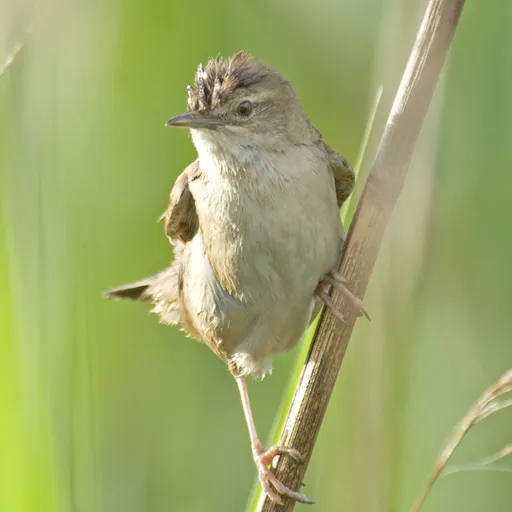
Savi's Warbler
Locustella luscinioides
Least Concern
Listen
XC730593 · Sonothèque ADVL · Pontorson, Manche, Normandie, France · CC0 1.0
Overview
Savi's warbler (Locustella luscinioides) is a small passerine bird and Old World warbler that breeds in Europe and the western Palearctic. It is a migratory species that spends the winter in northern and sub-Saharan Africa.
Identification
- Plumage: Uniform dark reddish-brown upper-parts, sometimes with a slight greenish tinge, and whitish-buff underparts.
- Markings: Indistinct buff eye-stripes, dark lores, and pale brown ear-coverts; lack of throat streaks distinguishes it from the river warbler.
- Size: Approximately 14 cm in length with a slender brown bill and brown legs.
- Song: A monotonous, mechanical, insect-like reeling trill that is lower pitched than a grasshopper warbler's and often preceded by low ticks.
Habitat
Found in reed beds, marshes, and lagoons with reeds, sedges, and marsh vegetation, often including scattered sallows or bushes. The breeding range includes parts of Europe, Turkey, Jordan, and Russia as far east as the Volga, while wintering grounds cover North Africa and regions of sub-Saharan Africa.
Diet
This insectivorous bird feeds on insects such as flies, beetles, moths, grubs, and damselflies, with small worms also believed to be part of its diet. It forages by flitting among reeds and undergrowth, though it may feed and roost in small flocks in its winter quarters.
Did you know?
The genus name Locustella is a diminutive of the Latin locusta (grasshopper), referring to the bird's insect-like song, while the specific name luscinioides means 'resembling a nightingale'. The common name honours Italian ornithologist Paolo Savi, who described the species after receiving specimens in 1821.
Sources
- Wikipedia · CC BY-SA 4.0
- Wikidata · CC0 1.0