
Common Grasshopper Warbler
Locustella naevia
Least Concern
Listen
XC730594 · Sonothèque ADVL · Bréhal, Manche, Normandie, France · CC0 1.0
Overview
The common grasshopper warbler (Locustella naevia) is a small passerine bird in the genus Locustella that breeds across much of temperate Europe and the western Palearctic. It is a migratory species that winters in northern tropical Africa and locally in India. The species is classified as Least Concern by the IUCN, with a large global population despite potential declines due to habitat loss.
Identification
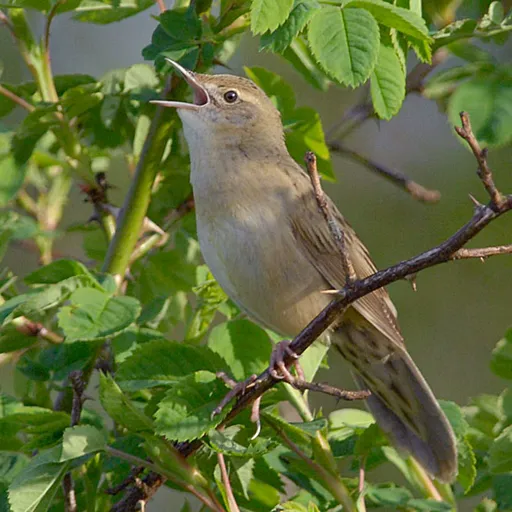
- Small, secretive bird approximately 12.5 cm long with pale olive-brown upper parts featuring central darker brown streaks and cream-coloured underparts with dark brown spots on the breast and flanks.
- Possesses a dark brown upper mandible and yellowish-brown lower mandible, along with slender pale yellowish-brown legs and brown irises with a faint eye streak.
- Produces a distinctive, high-pitched mechanical 'reeling' song that resembles an angler's reel or a distant mowing machine, performed with the beak wide open and the body vibrating.
- Extremely difficult to see as it skulks in undergrowth, but its presence is easily detected by its song, which can carry up to 1 km and is strongly ventriloqual.
Habitat
During the breeding season, it inhabits damp or dry locations with rough grass and bushes, such as fens, clearings, hedgerows, heaths, moors, and young plantations. The species migrates to the Sahel region of Africa, India, and Sri Lanka to overwinter, where it occupies similar vegetation types though its winter distribution is poorly understood due to its skulking behaviour.
Diet
This insectivorous bird feeds on a wide range of invertebrates including flies, moths, beetles, aphids, dragonflies, and mayflies, as well as spiders and woodlice. Chicks are specifically fed on aphids, green caterpillars, woodlice, and flies.
Did you know?
The bird has been observed feigning injury to distract potential predators, a deceptive tactic used to protect its nest or young.
Sources
- Wikipedia · CC BY-SA 4.0
- Wikidata · CC0 1.0