
Tricolored Munia
Lonchura malacca
Least Concern
Overview
The tricoloured munia (Lonchura malacca) is an estrildid finch native to Bangladesh, India, Sri Lanka, Pakistan, and southern China. It has also been successfully introduced to parts of the Caribbean, where it is considered an invasive species. The bird is classified as Least Concern on the IUCN Red List.
Identification
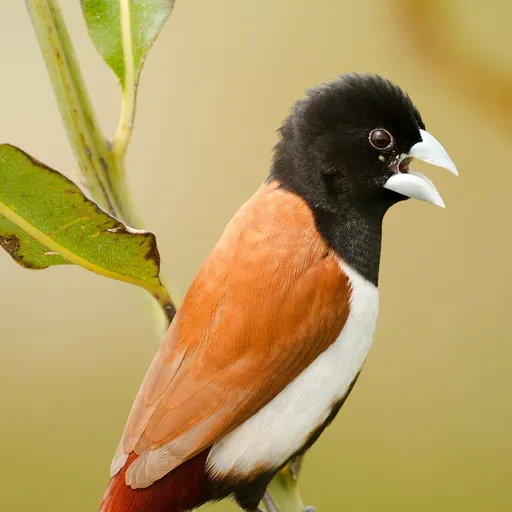
- Adults feature a black head, throat, and breast that extends to the belly and thighs, separated by a distinct white band across the lower breast and flanks.
- The upperparts are a warm chestnut, while flight feathers are dark brown with white or cream underwing coverts.
- Males exhibit reddish-maroon rump and uppertail coverts, whereas females have paler fringes on the uppertail coverts; both sexes typically display a gold edge on the coverts and central tail feathers.
- Medium-sized birds measuring 115 mm tall, with a culmen of 12–13 mm and grey legs and feet.
Habitat
This small, gregarious bird primarily inhabits wet grasslands and tropical lowland moist forests. It thrives in warm environments located near pools of water, reedbeds, marshes, and rice fields. In its native range, it is found across the Indian subcontinent and southern China, while in the Caribbean it has established populations in Trinidad, Jamaica, Hispaniola, Puerto Rico, Cuba, and Venezuela.
Diet
The tricoloured munia feeds mainly on grain and other seeds. It is particularly specialised in rice fields, which has led to its reputation as a pest for rice farmers in some regions. Its foraging is often concentrated in areas with abundant vegetation surrounded by water, such as reedbeds and marshes.
Did you know?
In the 1940s, these birds were imported to Venezuela by birdkeepers who hoped to breed them with local finches because of their song. However, the importation was driven by a misconception, as it was later discovered that the Munias could not sing, leading to their release into the wild where they eventually thrived as an invasive species.
Sources
- Wikipedia · CC BY-SA 4.0
- Wikidata · CC0 1.0