
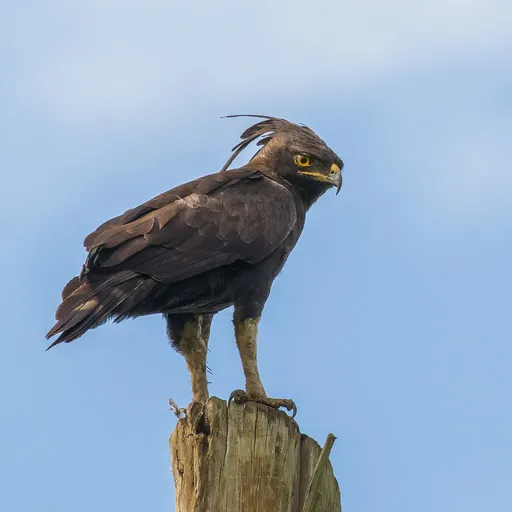
Long-crested Eagle
Lophaetus occipitalis
Least Concern
Overview
The long-crested eagle (Lophaetus occipitalis) is an African bird of prey characterised by its shaggy crest of feathers. It is currently placed in the monotypic genus Lophaetus within the family Accipitridae. This species is found throughout mid- and southern Africa, living mainly on forest edges and near moist areas.
Identification
- Adults are blackish-brown with long, thin feathers growing from the rear of the crown to form an erect crest.
- A white patch formed by primary feathers and median underwing coverts is visible on the upper and lower surfaces of the wing in flight.
- Bright yellow eyes in adults, which may be darker in females, along with a yellow cere and feet that pale to white in males.
- Body length of 53–58 cm, with females weighing 1,300–1,500 g and males 912–1,300 g.
Habitat
The long-crested eagle occurs in sub-Saharan Africa from Senegal and Gambia eastwards to Ethiopia and south to the Eastern Cape in South Africa. It is a bird of forest edges and moist woodland, particularly where these are near grassland, marsh, or water, but also uses drier woodland, mixed farmland, and exotic plantations. It ranges in altitude from sea level to 3,000 m, though it is unusual to find them above 2,000 m.
Diet
Rodents constitute up to 98% of the diet, including species such as the greater cane rat and vlei rats in southern Africa. It is a “sit and wait” hunter that scans the ground from a perch and swoops on prey with a gliding flight. It will also eat other vertebrates such as frogs, lizards, and birds, as well as invertebrates, fish, and fruit.
Did you know?
The species is named Kamusungu-sungu in Uganda. It is increasingly threatened by trichomoniasis, a disease spread by doves that causes major damage to the crop, pharynx, and mouth, eventually rendering the eagles unable to eat.
Sources
- Wikipedia · CC BY-SA 4.0
- Wikidata · CC0 1.0