
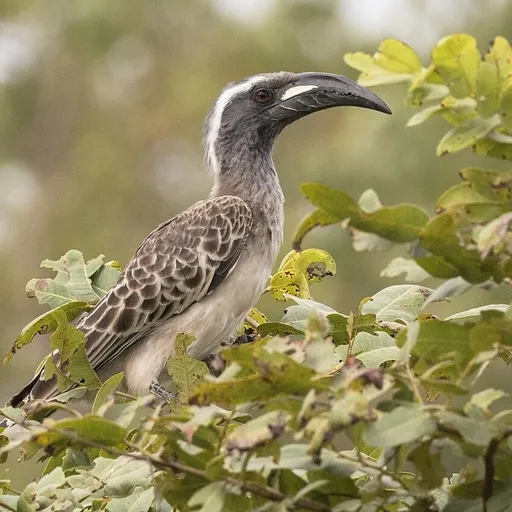
African Grey Hornbill
Lophoceros nasutus
Least Concern
Overview
The African grey hornbill (Lophoceros nasutus) is a widespread resident breeder in much of sub-Saharan Africa and the southwest of the Arabian Peninsula, belonging to the family of mainly tropical near-passerine hornbills. It is classified as a species of Least Concern, although escaped or deliberately released populations have established themselves in Florida, USA without evidence of breeding.
Identification
- Plumage: Grey and brown overall, with the head, flight feathers, and long tail appearing in a darker shade.
- Markings: A white line runs down each side of the crown and along the back, the latter being visible only in flight.
- Bill: Long and curved with a small casque on the upper culmen that is more prominent in males; males possess a dark upper mandible with a creamy-yellow mark or stripe, while females have tricoloured, red-tipped mandibles.
- Vocalisation: The bird advertises its presence with a distinctive piping pee-o pee-o pee-o call.
Habitat
This species inhabits open woodland and savannah environments. Its natural range extends widely across sub-Saharan Africa, encompassing regions from Senegal and Gambia to Ethiopia, central Kenya, and northern South Africa, as well as the southwest of the Arabian Peninsula.
Diet
The African grey hornbill is omnivorous, consuming a diet of insects, fruit, and reptiles. It forages mainly in trees.
Did you know?
Females seal themselves inside tree hollows using a wall made of mud, droppings, and fruit pulp, leaving only a narrow aperture for the male to pass food before the chicks and mother grow large enough for her to break out.
Sources
- Wikipedia · CC BY-SA 4.0
- Wikidata · CC0 1.0