
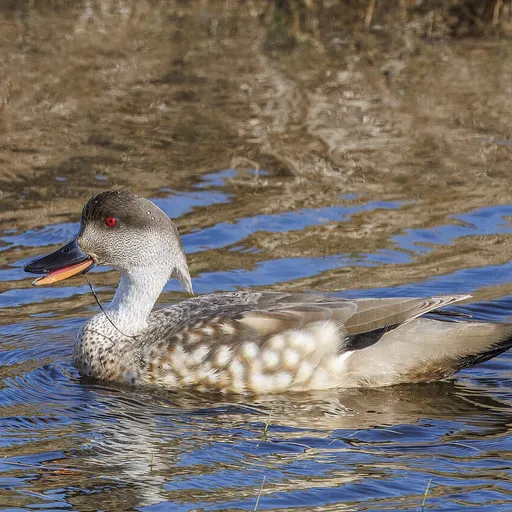
Crested Duck
Lophonetta specularioides
Least Concern
Overview
The crested duck, or South American crested duck, is a medium-sized waterfowl native to South America and the only member of the genus Lophonetta. It belongs to a South American clade that diverged early in dabbling duck evolution and is classified as Least Concern by the IUCN.
Identification
- Medium-sized duck with a distinct crest on the head, which is slightly more prominent in males than in females.
- Mantle, back and scapulars are dark brown with pale centres, creating a mottled appearance.
- Abdomen, flanks and tail coverts are light gray, contrasting with a distinctly elongated, black tail.
- Upperwing features iridescent coppery to greenish secondaries with a broad back band narrowly edged in white.
Habitat
Endemic to South America, this species inhabits lakes, marshes, and grassy areas ranging from shallow coastal bays to high elevation Andean lakes. Subspecies occupy different elevations, with one found between 2,500 and 4,800 metres in the Andes and the other below 1,500 metres in southern regions such as Patagonia and the Falkland Islands.
Diet
As a dabbling duck, it forages by sieving through mud, silt, or gravel to find macroinvertebrates. Its diet varies by habitat but typically includes zooplankton, clams, kelp, and other marine invertebrates.
Did you know?
Despite being non-gregarious and highly territorial, crested ducks often flock in areas where food supplies are unusually high. Males play a crucial role in the early development of ducklings, a cooperative behaviour that allows the species to live in close proximity to predatory gulls and skuas.
Sources
- Wikipedia · CC BY-SA 4.0
- Wikidata · CC0 1.0