
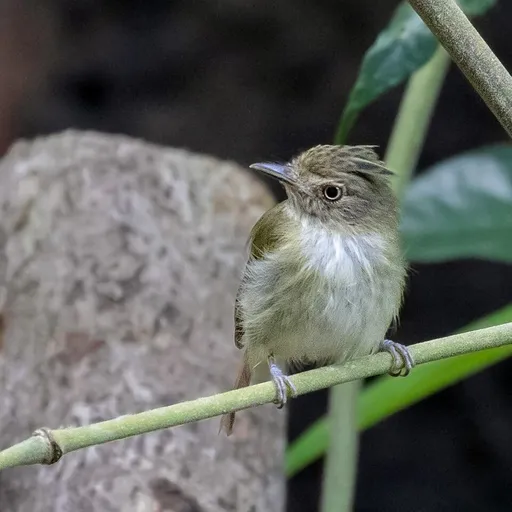
Helmeted Pygmy Tyrant
Lophotriccus galeatus
Least Concern
Overview
The helmeted pygmy tyrant (Lophotriccus galeatus) is a small bird in the tyrant flycatcher family, native to the northern Amazon Basin. It is assessed as Least Concern by the IUCN due to its large range and the relatively pristine condition of much of its habitat.
Identification
- Approximately 10 cm in length, weighing 6 to 7 g, with long black crown feathers edged in greyish olive that form a crest extending beyond the head.
- Olive upperparts with dusky wings showing two faint wing bars, and whitish underparts with faint grey streaks.
- Features a grey bill with a pink base to the mandible and yellowish to orangish white irises.
- Song consists of a series of 4–10 dry staccato 'pik' or 'trik' notes, sometimes ending in a warbled or trilled phrase.
Habitat
Found in southeastern Colombia, northern Peru, southern and eastern Venezuela, the Guianas, and northern Brazil, this species primarily inhabits the interior and edges of terra firme and várzea forests. It also utilises secondary forest, savanna woodlands, and forests on white-sand soil, reaching elevations of up to 1,100 m in Venezuela and Brazil.
Diet
Feeds exclusively on insects, foraging mostly alone in the forest's middle level or occasionally joining mixed-species feeding flocks. It perches inconspicuously and captures prey through short upward sallies from the perch to grab insects from leaves.
Did you know?
The nest is a domed bag hanging 2 to 10 m above the ground, featuring a small 'awning' near the bottom entrance. The genus name Lophotriccus is derived from Ancient Greek, combining 'crest' with trikkos, an unidentified small bird used in ornithology to denote a tyrant flycatcher.
Sources
- Wikipedia · CC BY-SA 4.0
- Wikidata · CC0 1.0