
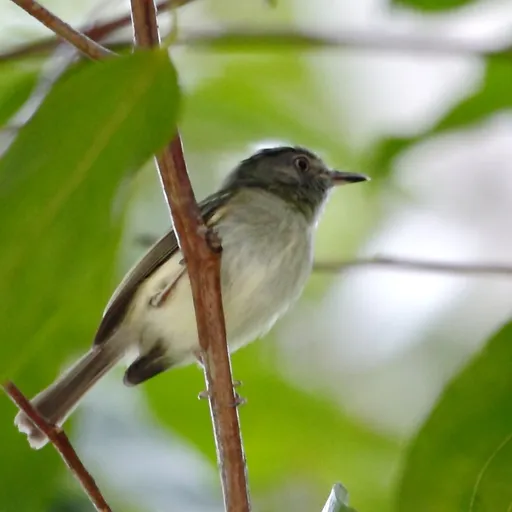
Double-banded Pygmy Tyrant
Lophotriccus vitiosus
Least Concern
Listen
XC922592 · JUAN ANTONIO ALONSO DE JUAN · Vereda La Máquina, Pacho, Cundinamarca, Colombia · CC BY 4.0
Overview
The double-banded pygmy tyrant (Lophotriccus vitiosus) is a small bird in the tyrant flycatcher family, Tyrannidae. It is a year-round resident found across several countries in northern South America.
Identification
- Approximately 10 cm long and weighing 6 to 8.5 g, with long crown feathers that form a crest occasionally erected and fanned.
- Adults possess a black crest with gray edges, a white face with whitish lores, and olive upperparts.
- Wings are dusky with greenish yellow to yellowish white edges on the flight feathers, creating two distinct wing bars.
- Throat and upper breast are white with dusky olive streaks, while underparts are mostly white with a light yellow wash on the flanks; all subspecies feature a straw-yellow iris, gray bill, and dusky pinkish legs.
- Song varies regionally, described as a descending, harsh trill such as 'turrrrrrew' or 'beerrrrrrp', alongside a quiet, tinkling 'pik' call.
Habitat
The species inhabits the tropical zone, primarily in humid terra firme and secondary forest, though it also occurs in várzea forest and both forest interiors and edges. Its range spans Brazil, Colombia, Ecuador, French Guiana, Guyana, Peru, and Suriname, reaching elevations of up to 800 m in Brazil.
Diet
The diet is assumed to consist mostly of insects, though it has not been detailed. The bird forages singly or in pairs from the middle levels of the forest to the canopy, rarely joining mixed-species feeding flocks. It perches inconspicuously and captures prey using short upward sallies from perches to grab it from leaves.
Did you know?
The species was originally described in 1921 under the genus Cometornis, but this name had to be replaced by Lophotriccus due to the taxonomic principle of priority. Additionally, its nest is a domed bag made of green moss and dried grass, typically hung from a tree branch about 4 m above the ground, sometimes over a stream.
Sources
- Wikipedia · CC BY-SA 4.0
- Wikidata · CC0 1.0