
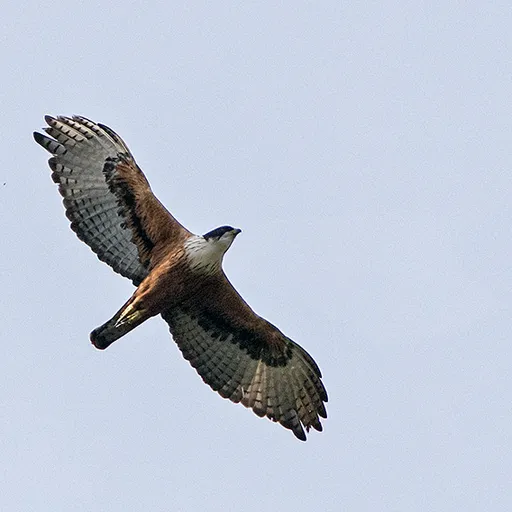
Rufous-bellied Eagle
Lophotriorchis kienerii
Near Threatened
Overview
The rufous-bellied eagle (Lophotriorchis kienerii) is a bird of prey in the family Accipitridae found in the forested regions of tropical Asia. Currently classified as Near Threatened, this species was historically placed in other genera but is now recognised as distinct enough to warrant its own monotypic genus.
Identification
- Plumage: Distinctive black hood with a short crest, contrasting chestnut underparts and wing coverts, and white throat and breast; females possess more black on the face.
- Posture and Structure: Perches in a very upright stance with the wingtip almost reaching the tail; the tarsus is fully feathered.
- Flight: In flight, the underwing lining is dark with black greater coverts, flight feathers are thinly barred with a black edge, and the tail is dark and barred.
- Juveniles: Feature very white underparts with dark markings on the body sides, head mask, and underwing coverts.
Habitat
The species inhabits mainly hill forests across southern and south-eastern Asia, including Sulawesi. In India, they are commoner in the Western Ghats than along the Himalayas, where they occur from Nepal to Assam, and are also present in parts of the Eastern Ghats.
Diet
Foraging primarily in flight, these eagles soar high over the forest canopy and dive to capture prey such as birds and mammals from the air, canopy, or forest floor. Recorded prey items include species the size of the Sri Lanka wood pigeon, Kalij pheasant, and junglefowl.
Did you know?
The rufous-bellied eagle constructs its nest by breaking off dry sticks and branches to build a large platform on a large, often bare tree, subsequently lining it with green leaves.
Sources
- Wikipedia · CC BY-SA 4.0
- Wikidata · CC0 1.0