
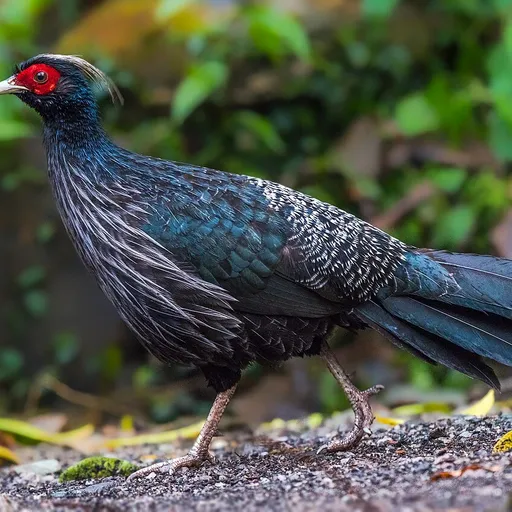
Kalij Pheasant
Lophura leucomelanos
Least Concern
Overview
The kalij pheasant, or simply kalij, is a Lophura leucomelanos found in forests and thickets, particularly in the Himalayan foothills spanning from India and Pakistan to western Thailand. It is a widespread species, although several eastern subspecies are considered threatened.
Identification
- Males are variable by subspecies but feature glossy bluish-black plumage with either a white or blue-black crest and white tail and upperparts.
- Females are overall brownish, often with pale-edged feathers that create a scaly appearance or distinct whitish and black underparts.
- Both sexes possess a bare red face and greyish legs, which distinguish the species from the red-legged silver pheasant.
- Males measure between 63 and 74 cm in length, while females are smaller, ranging from 50 to 60 cm.
Habitat
This species inhabits forests and thickets, with a strong association with the Himalayan foothills. Its geographic range extends from India, Nepal, and Pakistan eastwards to western Thailand, generally located west of the Irrawaddy River except for the L. l. oatesi subspecies which has been incorrectly reported on the eastern side.
Did you know?
The kalij pheasant was officially declared the bird of the Union Territory of Jammu and Kashmir on 21 October 2021. In the Kashmiri language, it is known as Wan Kokur or Wan Kokud, which translates to wild cock.
Sources
- Wikipedia · CC BY-SA 4.0
- Wikidata · CC0 1.0