
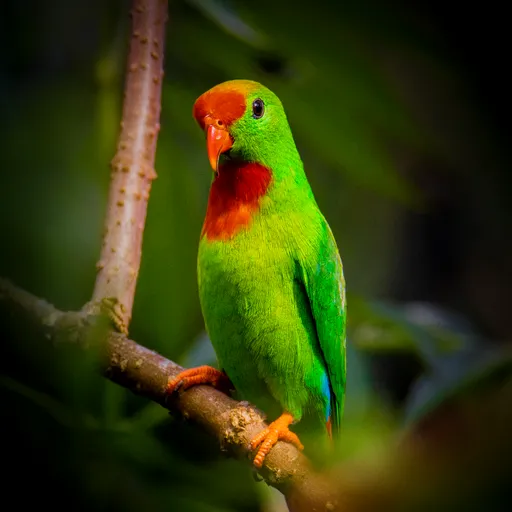
Philippine Hanging Parrot
Loriculus philippensis
Least Concern
Overview
The Philippine hanging parrot, also known as the colasisi from its local Tagalog name, is a small psittaculid parrot species endemic to the Philippines. Although listed as Least Concern by the IUCN, it faces significant threats from habitat loss and the illegal wildlife trade.
Identification
- Approximately 14 cm long with a short, rounded tail.
- Predominantly green plumage with varying areas of red, orange, yellow, and blue depending on the subspecies.
- Males display a red chin or upper chest, whereas females and juveniles lack this marking.
- Features a red beak, orange legs, and dark brown irises.
Habitat
Native to the Philippines, excluding the Sulu Archipelago and most of Palawan, this species inhabits tropical moist lowland forests, bamboo forests, and montane forests. It is also adaptable to human-modified environments such as coconut groves, secondary forests, and suburban areas, though it is rare above 1250 m.
Diet
The parrot feeds on nectar, flowers, and soft fruits such as figs. It usually forages alone or in pairs within the canopy or middle storeys of forests.
Did you know?
One of the few parrot species that uses nesting material, the female carries it back to the nest by tucking it between her own feathers.
Sources
- Wikipedia · CC BY-SA 4.0
- Wikidata · CC0 1.0