
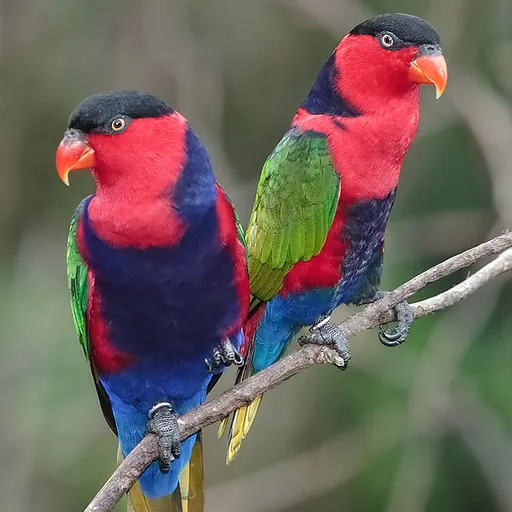
Black-capped Lory
Lorius lory
Least Concern
Overview
The black-capped lory (Lorius lory), also known as the western black-capped lory or tricolored lory, is a parrot found in New Guinea and adjacent smaller islands. It is a colourful and relatively robust species, with seven subspecies that vary considerably in plumage colour. The species remains overall widespread and common, though the cyanuchen subspecies is relatively rare.
Identification
- Measures approximately 31 cm (12 in) in length and is described as relatively robust.
- Features a red head and body around the wing, a black cap, and a grey-black cere.
- Displays green wings and yellow underwings, with blue legs and belly.
- Most subspecies exhibit a blue nape and mantle, the area between the wings on the back.
Habitat
The black-capped lory inhabits primary forest and forest edges in most lowland areas up to 1,000 m, extending sporadically to 1,750 m. It avoids monsoon forest and coconut plantations. The species is found in New Guinea and adjacent smaller islands, and is usually observed in pairs or occasionally in groups of ten or more.
Diet
Its diet consists of pollen, nectar, flowers, fruit, and insects.
Did you know?
The name 'lory' is derived from the Malay word for these brightly coloured parrots. The species was originally described by Carl Linnaeus in 1758 under the binomial name Psittacus lory, based on illustrations by George Edwards.
Sources
- Wikipedia · CC BY-SA 4.0
- Wikidata · CC0 1.0