
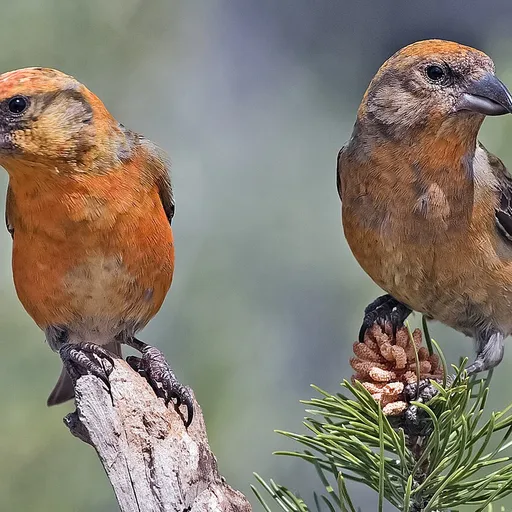
Red Crossbill
Loxia curvirostra
Least Concern
Listen
XC955857 · Sonothèque ADVL · Cabane Vauban (Carolles), Manche, Normandie, France · CC0 1.0
Overview
The red crossbill or common crossbill, Loxia curvirostra, is a small passerine bird in the finch family. It is recognised for its distinctive mandibles that cross at the tips, enabling it to extract seeds from conifer cones.
Identification
- Males are often red or orange, while females are green or yellow, though juveniles are greyish-green and streaked.
- Possesses a unique bill structure where the mandibles cross at their tips.
- Wings are entirely brownish-black, lacking the two bright white wing bars found in the similar two-barred crossbill.
- Typically 20 cm in length with a weight of 40–53 g.
Habitat
Red crossbills breed in a variety of coniferous forests across North America and Eurasia. They are considered nomadic and highly irruptive, moving widely when local conifer seed production fails, although some populations remain resident.
Diet
Their primary food source is conifer seeds, which they extract by using their crossed mandibles as leverage to separate the scales of conifer cones. They may also eat other fruits, such as apples, as noted in historical accounts of their foraging behaviour.
Did you know?
The plumage colour of certain subspecies, such as the Balearic, North African, and Cyprus crossbills, reflects the anthocyanin content of the specific pine cones they feed on, with these pigments being transferred directly to their feathers.
Sources
- Wikipedia · CC BY-SA 4.0
- Wikidata · CC0 1.0